

Fact.MR forecasts the wearable healthcare devices market to grow at an 8.5% CAGR, supported by personal health monitoring and chronic disease management.
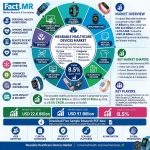
October 23, 2026 Global wearable healthcare devices market demand is projected to reach USD 51 billion by 2036, rising from USD 22.6 billion in 2026 at a compound annual growth rate (CAGR) of 8.5%, according to Fact.MR analysis updated on February 26, 2026. The forecast represents an absolute dollar opportunity of USD 28.4 billion over the decade, as consumers and healthcare providers seek better ways to monitor health outside traditional clinical settings.
The shift extends beyond fitness tracking. Wearable healthcare devices are increasingly relevant to chronic disease management, remote patient monitoring, and preventive care. Fact.MR identifies consumer-grade devices as the leading grade segment, projected to account for 60% of the market by 2026. Online distribution is also expected to capture 43% of the market share in the same year, reflecting the growing role of e-commerce in device purchasing.
Get detailed market forecasts, competitive benchmarking, and pricing trends: https://www.factmr.com/connectus/sample?flag=S&rep_id=14407
Wearable Healthcare Devices Market Growth Reflects Changing Care Needs
Healthcare monitoring is becoming more personal. Devices worn on the body can track heart rate, physical activity, sleep patterns, glucose levels, and other vital signs, giving users access to health information beyond periodic medical appointments.
The market covers fitness trackers, smartwatches, patches, and smart clothing, alongside diagnostic, monitoring, and therapeutic devices. Applications include general health and fitness, remote patient monitoring, and home healthcare. Fact.MR excludes stationary medical equipment and general consumer electronics without health-monitoring functions from its market definition.
Demand is being shaped by the need to monitor diabetes and cardiovascular conditions over time. Connected devices can support ongoing observation and help patients share relevant information with healthcare professionals. Their role in care, however, depends on the device's capabilities, clinical validation, and the way health data is interpreted.
Device pricing and privacy remain practical barriers. Higher costs can restrict adoption in some markets, while concerns about the collection and use of sensitive health information may affect consumer confidence. Manufacturers must consider these issues alongside sensor performance and connectivity when developing products for healthcare applications.
Consumer Devices and Online Sales Shape Market Opportunities
Consumer-grade wearable healthcare devices are forecast to hold 60% of the market by 2026, according to Fact.MR. Smartwatches and fitness trackers serve users who want to monitor everyday activity, heart rate, and sleep without necessarily requiring a clinical-grade device.
Online channels are projected to account for 43% of distribution by 2026. Consumers can compare product specifications, read reviews, and evaluate prices before purchasing. For manufacturers, this channel offers a direct route to customers across markets, although product information must communicate monitoring capabilities and limitations clearly.
Clinical-grade wearables represent another area of development. Advanced biosensors and real-time connectivity can support remote monitoring and the management of specific health conditions. These devices may carry higher prices than basic fitness products, making clinical requirements and the value delivered to patients important considerations for buyers.
India Leads Country-Level Growth Forecasts
Fact.MR projects India to record the fastest growth among the seven countries highlighted in its analysis, with wearable healthcare devices demand rising at a 9.7% CAGR through 2036. Growing health awareness, expanding access to digital technology, and increased interest in fitness tracking support the country's outlook.
China follows at an 8.6% CAGR, reflecting its large population and expanding healthcare needs. South Korea is forecast to grow at 6.8%, while Spain is projected to record a 5.0% CAGR. Canada follows at 4.7%, and France at 4.4%.
The USA has the lowest projected CAGR among these seven markets, at 2.7%. Fact.MR attributes this slower pace to market maturity, while continued innovation in wearable healthcare technology supports ongoing demand. These country forecasts indicate that market opportunities will differ according to adoption patterns, healthcare priorities, and existing levels of technology penetration.
Industry Developments Connect Wearables With Clinical Care
Competition spans consumer technology companies and established medical device manufacturers. Apple Inc., Samsung Electronics Co., Ltd., and Fitbit, a brand of Google LLC, participate in consumer health and fitness monitoring. Medtronic plc and Abbott Laboratories focus on medical technologies, including solutions for chronic disease management.
Other companies profiled by Fact.MR include GE HealthCare Technologies Inc., Koninklijke Philips N.V., OMRON Corporation, Movano Health, Inc., and Corsano Health B.V.
Recent developments illustrate the industry's wider direction. On July 2025, Samsung Electronics acquired the U.S. digital health platform Xealth, according to the supplied report, to connect wearable data more closely with hospital medical records and clinical workflows. On October 3, 2024, ŌURA introduced the Oura Ring 4 with its Smart Sensing platform, increasing signal pathways from eight to 18 to accommodate differences in finger shape and movement during sleep.
These examples show how product development and clinical integration are addressing different needs within the market. They do not, by themselves, establish a change in market share.
Fact.MR Research Identifies Priorities for Market Participants
“The wearable healthcare devices market is expected to experience significant growth, fueled by increasing consumer demand for health management solutions, chronic disease tracking, and the integration of wearable technology into preventive healthcare practices,” said Shambhu Nath Jha, Principal Consultant at Fact.MR. He added that advanced biosensors and real-time connectivity would be important to the development of medical-grade devices.
For companies planning future investment, the forecast points to opportunities in product functionality, online availability, and devices designed for ongoing monitoring. The balance between consumer convenience, clinical usefulness, affordability, and data privacy will remain relevant as manufacturers address different healthcare needs.
Fact.MR's forecast combines top-down healthcare technology adoption estimates with bottom-up shipment and revenue data. The research draws on interviews with device manufacturers, clinicians, and healthcare technology integrators, alongside industry reports, regulatory filings, and market intelligence publications. Findings are reviewed against production, adoption, and usage statistics.
View Related Reports :
https://ayushjadhavblogs.blogspot.com/2026/10/china-pcr-packaging-market-forecast-to.html
https://sohomoy.com/blogs/69940/Medical-Tourism-Market-to-Reach-USD-1-000-2-Billion
About Fact.MR
Fact.MR is a market research and consulting firm that provides industry analysis, market sizing, forecasts, and strategic insights for businesses across sectors. Its research combines primary interviews, secondary sources, and market modeling to assess demand patterns, competitive developments, and growth opportunities.