
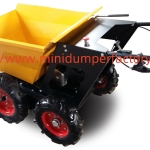

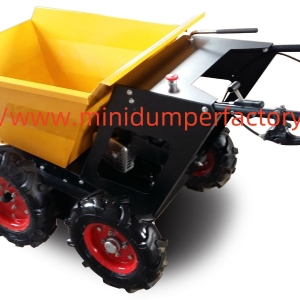
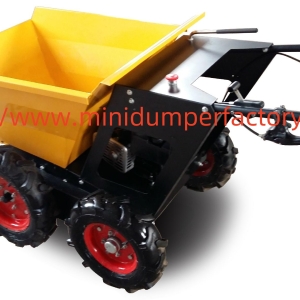
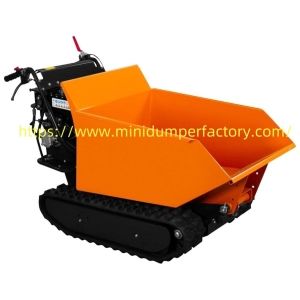
Mini Dumper Wheelbarrowand traditional wheelbarrow designs both serve the same essential purpose: transporting materials across short distances on job sites. However, their structure, operating method, and productivity impact differ in several important ways. Understanding these differences helps contractors, landscapers, and property maintenance teams choose equipment that matches real working conditions.
A traditional wheelbarrow relies entirely on manual force. The operator lifts the handles, balances the load, and pushes the unit forward. This simple design has been widely used for decades in gardens, small construction areas, and renovation sites. It requires minimal mechanical maintenance and can be cost-effective for light, occasional use. However, repeated lifting and pushing of heavy materials can increase physical strain, particularly on uneven terrain.
In contrast, powered material carriers introduce assisted movement. Rather than relying solely on physical effort, the operator guides the machine while the drive system provides forward motion. This reduces fatigue during extended working hours. On projects that involve transporting gravel, soil, sand, or construction debris multiple times per day, assisted propulsion can support more consistent productivity.
Load handling is another point of comparison. Manual carts typically carry moderate volumes suitable for smaller tasks. When loads become heavier, stability becomes more challenging, especially on slopes. Powered equipment is often designed with reinforced frames and balanced weight distribution. This structural difference can improve control during loading and unloading operations.
Terrain adaptability also separates these two options. Traditional wheelbarrows perform well on flat, stable surfaces but may require extra effort on loose gravel, muddy ground, or inclined pathways. Machines equipped with drive systems can provide smoother movement across varied surfaces, depending on tire configuration and motor design. For landscaping contractors working in residential areas with mixed terrain, this can influence daily efficiency.
Maintenance requirements vary as well. Manual units require inspection of wheels and structural components but have limited mechanical systems. Powered equipment introduces additional elements such as motors, batteries, or fuel engines, depending on the model. While this adds maintenance responsibilities, it also supports improved transport consistency when properly serviced.
Operational cost evaluation depends on usage frequency. For occasional gardening tasks, manual tools may remain practical. For contractors handling recurring transport work across multiple projects, mechanized assistance may reduce labor intensity over time. Calculating labor hours, workload volume, and site conditions provides clearer insight into long-term value.
Minidumperfactory develops compact transport solutions designed for practical job site applications. By focusing on structured production processes and balanced equipment design, Minidumperfactory supports contractors seeking steady performance in landscaping and construction environments. Attention to maneuverability and controlled handling helps address real working challenges without unnecessary complexity.
Choosing between manual and powered transport tools ultimately depends on project scale, terrain conditions, and labor planning. Assessing daily workload and operator comfort can guide equipment selection decisions that align with business goals.
Additional insights into compact electric transport equipment are available at
https://www.minidumperfactory.com/news/industry-news/what-is-an-electric-garden-loader.html