




In modern pharmaceutical development, biotechnology research, nanomaterial engineering, and functional food manufacturing, achieving ultra-fine particle size and highly stable dispersion is no longer optional — it has become a critical requirement for product quality and process efficiency.
Traditional homogenization methods often struggle to deliver consistent nano-scale particle reduction, especially when dealing with complex formulations, high-viscosity materials, or sensitive biological compounds. In many cases, conventional systems cannot provide the combination of energy intensity, process stability, and precision required by advanced laboratories and pilot-scale production environments.
This is where the Ultra High Pressure Homogenizer demonstrates significant technical advantages.
Operating at pressures up to 1800 bar (180 MPa / 26,100 psi), this advanced homogenization technology generates extremely powerful shear force, turbulence, cavitation, and particle collision effects, enabling highly efficient nano-scale processing for demanding scientific and industrial applications.
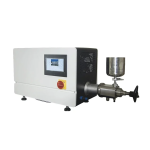
As a professional manufacturer of high-pressure processing systems, Shanghai Zhenxin Technology Co., Ltd. has developed a compact and high-performance ultra high pressure homogenization platform designed specifically for laboratory research, pilot production, and precision formulation development.
Understanding Ultra High Pressure Homogenization Technology
Ultra high pressure homogenization works by forcing liquid materials through a specially engineered micro-structured interaction chamber under extremely high pressure.
As the material passes through the homogenizing valve at pressures reaching 180 MPa, several intense physical effects occur simultaneously:
- Extreme shear force
- High-speed turbulence
- Cavitation bubble collapse
- Particle impact and collision
These combined forces break down particles into sub-micron or nano-scale sizes while improving dispersion uniformity and emulsion stability.
Compared with conventional mixing or emulsification systems, ultra high pressure homogenizers provide significantly higher energy density, allowing for more precise particle engineering.
Why 1800 Bar Pressure Makes a Difference
The 1800 bar operating pressure is one of the key factors that separates ultra high pressure homogenization from standard homogenization technologies.
At this pressure level, the system can effectively process:
- Tough biological cell structures
- Nano-emulsion formulations
- Lipid nanoparticles
- High-viscosity suspensions
- Functional food emulsions
- Advanced material dispersions
For biotechnology applications, the energy generated is sufficient to disrupt difficult microbial cell walls, including yeast and certain bacterial strains, making intracellular extraction more efficient.
For nanotechnology applications, ultra high pressure processing helps achieve highly uniform particle distribution and improved material stability.
Adjustable Pressure for Precise Process Control
Different materials require different homogenization intensities. One major advantage of the system developed by Shanghai Zhenxin Technology Co., Ltd. is its adjustable pressure capability.
Operators can optimize pressure settings according to formulation characteristics and process objectives.
Lower Pressure Applications
Lower pressure settings are suitable for:
- Soft emulsions
- Protein dispersion
- Heat-sensitive materials
- Shear-sensitive compounds
High Pressure Applications
Higher pressure settings are commonly used for:
- Cell disruption
- Nano-particle preparation
- High-viscosity formulations
- Liposome production
- Stable pharmaceutical suspensions
The system also features a maximum design pressure of 2070 bar, providing an additional engineering safety margin for long-term operational reliability.
Zero Residue Design for Laboratory Precision
In pharmaceutical and laboratory environments, sample residue can create serious challenges, including:
- Cross-contamination
- Material waste
- Inaccurate experimental results
- Reduced process reproducibility
To address these issues, Shanghai Zhenxin Technology Co., Ltd. integrates a zero-residue internal structure into the homogenizer design.
This 0 ml residue configuration is particularly valuable for:
- High-value biologics
- Precious nano-materials
- Limited-volume research samples
- Pharmaceutical R&D applications
Complete material recovery improves both cost efficiency and experimental consistency.
Compact Design with Industrial-Level Performance
Although the homogenizer operates at ultra-high pressure, the overall system remains remarkably compact.
Technical Specifications
- Dimensions: 1070 × 340 × 460 mm
- Total Weight: Under 60 kg
- Motor Power: 3.0 kW
This compact footprint makes the system highly suitable for:
- Research laboratories
- University facilities
- Pilot plants
- Small-scale production environments
Despite its relatively small size, the machine is engineered using high-strength alloy structures and precision-machined internal parts to ensure stable performance under extreme pressure cycles.
Feed Particle Compatibility and Processing Flexibility
The system supports feed particle sizes up to 100 microns, reducing the need for extensive pre-processing before homogenization.
For best processing performance, operators should consider:
- Pre-filtration for larger particle aggregates
- Viscosity optimization for stable flow
- Temperature monitoring during repeated processing cycles
Proper process setup helps maximize dispersion efficiency while maintaining formulation stability.
Major Industry Applications
The versatility of ultra high pressure homogenization technology allows it to support a broad range of advanced industries.
Biotechnology and Life Sciences
High-pressure cell disruption enables efficient extraction of intracellular proteins and bioactive compounds.
Applications include:
- Cell lysis
- Protein extraction
- Biological sample preparation
Pharmaceutical Development
The system supports advanced pharmaceutical processing, including:
- Nano-suspension preparation
- Liposomal drug delivery systems
- Particle size stabilization
- Uniform active ingredient dispersion
Food and Functional Beverage Industry
Ultra high pressure homogenization improves:
- Emulsion stability
- Nutrient bioavailability
- Texture consistency
- Product shelf life
Nanomaterials and Advanced Chemistry
The homogenizer can also disperse advanced materials such as:
- Graphene
- Ceramic nanoparticles
- Industrial pigments
- Functional nano-additives
Its processing capacity of up to 15 L/H makes it ideal for laboratory-scale and pilot-scale applications.
Engineering Reliability and Safety
Operating at pressures above 1800 bar requires extremely robust engineering standards.
Shanghai Zhenxin Technology Co., Ltd. integrates multiple safety and reliability systems, including:
- Reinforced pressure chamber construction
- Precision pressure monitoring systems
- High-strength sealing technology
- Safety valve protection systems
The maximum design pressure of 2070 bar provides an important structural safety buffer, helping reduce mechanical fatigue and extending equipment lifespan.
Why Choose Shanghai Zhenxin Technology Co., Ltd.?
Shanghai Zhenxin Technology Co., Ltd. focuses on delivering advanced homogenization systems designed for scientific precision and industrial reliability.
Key advantages include:
- Advanced high-pressure engineering expertise
- Precision manufacturing capability
- Laboratory-focused equipment optimization
- Stable pressure control performance
- Compact industrial-grade structure
The company continues developing high-efficiency homogenization technologies for pharmaceutical, biotechnology, food, and nanomaterial industries worldwide.
Final Thoughts
As industries increasingly demand nano-scale processing precision, stable emulsification, and efficient biological disruption, ultra high pressure homogenization has become an essential processing technology.
The 1800 bar Ultra High Pressure Homogenizer developed by Shanghai Zhenxin Technology Co., Ltd. combines adjustable pressure control, zero-residue processing, compact design, and laboratory-grade engineering performance into a highly efficient solution for modern scientific applications.
For laboratories and industrial users seeking reliable nano-scale processing capability, ultra high pressure homogenization is no longer simply an advanced option — it is becoming a fundamental requirement for next-generation material and biological processing.
https://www.zinscien.com/compact-powerhouse-advanced-ultra-high-pressure-homogenizer-solutions.html