
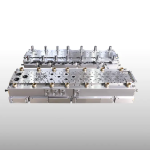


A stamping mold manufacturer plays a key role in determining the precision, durability, and stability of stamping dies used in motor core production. Unlike standard tooling products, these molds are typically custom-designed based on motor size, structure, production volume, and press machine conditions. Each design requires matching dimensional accuracy with long-term wear resistance to ensure stable output during continuous stamping operations.
A stamping mold manufacturer must consider multiple technical factors during design and production, including material selection, heat treatment process, and die structure layout. In progressive die systems, multi-row configurations are often used to increase production efficiency, but they also require tighter control over alignment and material flow. Improper design or insufficient hardness control can lead to burr formation, dimensional drift, or early wear during operation.
In practical applications, a stamping mold manufacturer is expected to evaluate manufacturability based on part drawings and production requirements rather than directly following design inputs without adjustment. Factors such as clearance, radius design, and stack pressure can influence the final performance of motor cores. Communication between tool designer and user is often part of the development process to ensure stable forming results.
After delivery, the die system continues to require maintenance such as sharpening, inspection, and occasional part replacement. Record tracking and technical support from the manufacturer help maintain consistent operation over long production cycles.