

Key Highlights
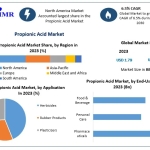
- Global market valued at USD 1.79 billion in 2023.
- Market expected to reach USD 2.79 billion by 2030.
- Forecast CAGR stands at 6.5% during 2024–2030.
- Europe accounted for the largest market share in 2023.
- Food preservatives remain the largest commercial application.
- Herbicides generated the highest application revenue.
- Rubber products are projected to register strong future demand.
- Bio-based propionic acid is emerging as a strategic investment area.
- Food safety regulations continue to support preservative adoption.
- Animal feed demand remains a stable source of long-term consumption.
Why This Matters Now
Food manufacturers are extending shelf life while reducing waste under tighter food safety regulations. Livestock producers are increasing feed preservation to improve productivity amid rising meat consumption. At the same time, chemical producers are investing in bio-based propionic acid to reduce carbon emissions and diversify raw material sources. These shifts are expanding the market beyond traditional preservative applications and creating new opportunities across industrial chemicals, pharmaceuticals, and sustainable materials.
Market Overview
Propionic acid Market is a short-chain carboxylic acid used primarily as a preservative in food, animal feed, pharmaceuticals, cosmetics, herbicides, and industrial chemicals. Its antimicrobial and antifungal properties make it an essential ingredient for extending product shelf life and maintaining quality.
Demand continues to rise as processed food consumption increases worldwide. Urbanization, changing consumer lifestyles, and higher demand for packaged foods have increased the need for reliable preservation technologies. Livestock expansion is also driving consumption as feed manufacturers require effective solutions to prevent mold growth and nutrient loss.
Supply dynamics are evolving with growing interest in renewable feedstocks. Manufacturers are exploring bio-based production routes to reduce dependence on petrochemical inputs while meeting sustainability targets. However, commercial-scale production remains constrained by high capital costs and process optimization challenges.
Macroeconomic factors including stricter food safety regulations, agricultural modernization, rising disposable income, and expanding pharmaceutical manufacturing continue to support long-term market demand.
Key Trends Driving Growth
The industry is moving toward bio-based propionic acid produced through fermentation and renewable feedstocks. This transition supports corporate sustainability goals while reducing lifecycle emissions.
Food safety regulations continue to encourage the use of approved preservatives with proven antimicrobial performance. Regulatory compliance is becoming a competitive advantage for manufacturers supplying food processors worldwide.
Demand for natural preservation solutions is increasing as consumers seek products with longer shelf life and fewer synthetic additives. Propionic acid benefits from its naturally occurring characteristics and established regulatory acceptance.
Raw material price volatility remains an important challenge for conventional producers. Companies are investing in production efficiency and diversified sourcing strategies to reduce cost fluctuations.
International trade continues to strengthen market expansion as food processing, animal nutrition, and specialty chemical industries increasingly operate through global supply chains.
Explore detailed analysis, insights, and growth opportunities : https://www.maximizemarketresearch.com/request-sample/24681/
Segment Insights
Dominant Segment – Herbicides
The herbicides segment generated the highest revenue in 2023 and is expected to maintain market leadership throughout the forecast period.
Growing agricultural production is increasing the need for effective weed management. Propionic acid-based herbicides help improve crop productivity by limiting competition for nutrients, sunlight, and water. Their relatively lower resistance profile compared with conventional herbicides also supports adoption in modern farming systems.
For manufacturers, this translates into steady agricultural demand supported by expanding cultivated land and precision farming technologies.
Fastest-Growing Segment – Rubber Products
The rubber products segment is expected to record significant growth during the forecast period.
Demand is being supported by expanding automotive production, infrastructure development, medical equipment manufacturing, and consumer goods. Propionic acid improves flexibility, resilience, and chemical resistance in rubber formulations, making it valuable across industrial applications.
Growth in sustainable rubber production is also creating opportunities for bio-based propionic acid suppliers seeking higher-value industrial markets.
Additional Key Segments
Food Preservatives remain one of the market's most stable segments due to continuous demand from bakery products, cheese, packaged foods, and processed foods. Manufacturers benefit from increasing regulatory focus on food safety and waste reduction.
Pharmaceuticals continue expanding usage as antimicrobial ingredients gain wider applications across specialty formulations.
Personal Care applications are gradually increasing as cosmetic manufacturers seek multifunctional ingredients with preservation capabilities.
Agriculture remains a foundational end-user industry as both herbicide production and animal feed preservation continue generating consistent demand.
Regional Growth Story
Europe remains the largest regional market with approximately 35% market share. Strong food processing industries, strict food safety regulations, and established chemical manufacturing capacity continue supporting regional leadership. The United Kingdom and France remain important consumption centers due to their mature food and beverage industries.
North America maintains steady demand through food processing, animal nutrition, and industrial chemical manufacturing. Innovation in specialty chemicals and advanced manufacturing supports stable consumption.
Asia-Pacific represents the strongest long-term expansion opportunity. Rising urbanization, increasing packaged food consumption, expanding livestock production, and rapid industrialization across China, India, and Southeast Asia are accelerating demand.
Middle East & Africa continue experiencing gradual market development supported by food processing investments, agricultural modernization, and growing industrial activity.
Competitive advantages are gradually shifting toward regions capable of combining low-cost manufacturing with sustainable production technologies.
Competitive Landscape
Competition remains concentrated among established global chemical manufacturers with integrated production capabilities, extensive distribution networks, and diversified application portfolios.
BASF SE, DowDuPont, Eastman Chemical Company, and Perstorp maintain strong competitive positions through broad product portfolios serving food, agriculture, and industrial customers. Their scale provides operational efficiency and regulatory expertise across multiple regions.
Specialty manufacturers including Corbion N.V., OXEA GmbH, DAICEL CORPORATION, Merck KGaA, and Celanese Corporation are strengthening market positions through application-focused product development and investments in higher-value specialty chemicals.
Regional producers such as Krishna Chemicals, Otto Chemie Pvt. Ltd., and Macco Organiques Inc. continue expanding presence by addressing local supply requirements and customized customer applications.
Competitive positioning is increasingly influenced by investments in bio-based production technologies, sustainable manufacturing, and regulatory compliance rather than production volume alone.
Recent Developments
- Industry participants increased focus on developing bio-based propionic acid production technologies.
- Manufacturers continued investing in sustainable production processes using renewable feedstocks.
- Market participants expanded research into propionic acid applications for bioplastics and biofuels.
- Companies strengthened product portfolios serving food preservation and animal nutrition industries.
- Continued investment in formulation technologies improved herbicide application efficiency and environmental performance.
Future Outlook
Companies that successfully commercialize cost-effective bio-based propionic acid while strengthening food preservation and agricultural supply chains will capture the greatest competitive advantage as sustainability becomes the industry's primary differentiator.
Explore More: Visit our website for Additional reports :
Malaysia Nutritional Supplements Market https://www.maximizemarketresearch.com/market-report/malaysia-nutritional-supplements-market/224986/
Crackers Market https://www.maximizemarketresearch.com/market-report/global-crackers-market/114649/
About Maximize Market Research
Maximize Market Research Pvt. Ltd. (MMR) is a global market research and consulting company that provides reliable, data-focused, and practical business insights. The firm serves a wide range of industries, including healthcare, pharmaceuticals, technology, automotive, electronics, chemicals, personal care, and consumer goods. Through market forecasts, competitive analysis, strategic consulting, and industry impact assessments, MMR helps organizations understand changing market conditions, identify growth opportunities, and make informed business decisions for long-term success.
Contact Us :
2nd Floor, Navale IT Park Phase 3
Pune Banglore Highway, Narhe
Pune, Maharashtra 411041, India
+91 9607365656
sales@maximizemarketresearch.com