



In heavy industrial manufacturing, material handling has a direct impact on productivity, workplace safety, and overall operating efficiency. Automotive plants, steel fabrication workshops, machinery manufacturers, and logistics facilities all need reliable systems for moving heavy loads accurately and safely.
Traditional top-running EOT cranes remain widely used, but they are not always ideal for facilities with limited headroom, restricted floor space, or existing buildings that were not originally designed for large crane runway structures. In these situations, underslung EOT cranes offer an alternative approach by using the lower flange of the runway structure and suspending the crane bridge beneath it.
As an experienced precision underslung EOT cranes factory, Goldcrane focuses on engineering lifting systems that combine structural reliability, smooth operation, flexible installation, and practical maintenance requirements.
What Makes an Underslung EOT Crane Different?
The fundamental difference is the position of the crane bridge.
In a conventional top-running overhead crane, the bridge travels on rails positioned on top of runway beams. An underslung EOT crane, also called an under-running crane, travels beneath the runway beams, with its wheels running along the lower flange.
This configuration can provide several practical advantages.
First, it can make better use of the available overhead space. The bridge can travel beneath the supporting structure while the hoist and trolley move within the working area below. This can be especially useful where building height or structural arrangement makes a conventional top-running crane difficult to install.
Second, the under-running arrangement can provide favorable side approaches. The crane may be able to reach positions closer to walls and other areas that would otherwise be difficult to access, helping manufacturers make better use of their existing production space.
A Practical Solution for Existing Buildings
One of the most attractive features of an underslung bridge crane is its potential for integration into existing facilities.
Installing a conventional top-running crane in an older workshop may require additional columns, runway supports, or substantial structural modifications. These changes can increase both construction costs and installation time.
An under-running system may allow the crane runway to be suspended from suitable existing building structures, provided that professional structural calculations confirm their capacity.
This does not mean that every existing roof structure can support a crane. Building structure, suspension loads, dynamic effects, span, support spacing, and crane duty must all be evaluated before installation.
For this reason, choosing an experienced underslung EOT crane manufacturer is important. Proper engineering begins with understanding the building as well as the lifting application.
Engineering Behind Reliable Goldcrane Crane Systems
A crane's performance depends on much more than its rated lifting capacity. Structural design, component alignment, drive systems, controls, and manufacturing quality all influence long-term reliability.
At Goldcrane, engineering considerations can include structural analysis of bridge girders to achieve an appropriate balance between strength, rigidity, weight, and deflection. Proper structural design helps maintain stable load handling during lifting and traveling operations.
End-truck alignment is another important factor. Poor wheel alignment can contribute to skewing, uneven wheel loading, track wear, and increased maintenance requirements. Precision machining and careful assembly help support smoother crane travel and reduce unnecessary mechanical stress.
Travel performance can also be improved through variable-frequency drive technology. VFD-controlled crane drives provide smoother acceleration and deceleration compared with simple full-speed starting and stopping. This can reduce sudden load movement, improve positioning control, and help protect mechanical components.
Where Are Underslung EOT Cranes Used?
The flexibility of an industrial underslung crane system makes it suitable for many applications.
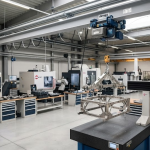
In automotive and aerospace manufacturing, accurate load positioning can support assembly operations involving engines, chassis components, tooling, and other valuable parts.
In steel fabrication and general engineering workshops, cranes can move welded structures, steel plates, fabricated components, tools, and workpieces between cutting, welding, machining, and assembly stations.
Warehouses and logistics facilities can also use overhead cranes to handle heavy materials while keeping the floor available for forklifts, storage, and other operations.
The correct crane configuration depends on load characteristics, lifting frequency, travel distance, working height, available building structure, and the required operating environment.
Safety Should Be Designed Into the System
Heavy material handling requires a strong focus on safety. A well-designed underslung EOT crane system should incorporate appropriate protection and control features according to the application and applicable regulations.
Overload protection can help prevent lifting beyond the crane's rated capacity. Emergency-stop functions provide a rapid method of stopping crane movement when necessary. Limit switches can control travel or lifting boundaries, while anti-collision systems can be considered when multiple cranes operate within the same runway area.
Safety, however, is not limited to electronic devices. Proper structural engineering, mechanical design, operator training, inspection, and preventive maintenance are equally important.
Maintenance and Total Cost of Ownership
The purchase price of a crane is only one part of its total cost. Downtime, component replacement, maintenance labor, energy consumption, and service availability can have a significant impact on long-term operating expenses.
For this reason, low-maintenance crane design should be considered during the selection process. Components such as gearboxes, brakes, electrical panels, wheels, and control systems should be accessible for inspection and servicing.
Smooth acceleration, correct alignment, appropriate component selection, and regular preventive maintenance can help reduce unnecessary wear and improve equipment availability.
Why Goldcrane?
For companies searching for a precision underslung EOT cranes factory, Goldcrane combines crane engineering, manufacturing capabilities, and application-focused design to address different industrial lifting requirements.
Rather than treating every project as a standard configuration, the crane should be evaluated according to the customer's building conditions, load requirements, working area, operating frequency, and material-flow objectives.
The goal is not simply to install a crane. It is to create a lifting system that fits naturally into the production environment.
Conclusion
Modern factories need material-handling solutions that make efficient use of available space while maintaining safe and precise load movement. Underslung EOT cranes can provide an effective solution for facilities where headroom, floor space, or existing building structures create challenges for conventional top-running cranes.
From structural analysis and precision manufacturing to VFD-controlled travel, overload protection, and maintenance-friendly design, every part of the crane contributes to its long-term performance.
With application-focused engineering and industrial manufacturing experience, Goldcrane provides underslung crane solutions designed to help manufacturers improve material flow, utilize overhead space more effectively, and build a safer and more productive working environment.
https://www.goldcraneglobal.com/why-global-industries-choose-precision-underslung-eot-cranes.html