



In high-speed metal forming, manufacturers are constantly looking for ways to improve dimensional accuracy, increase tooling life, and maintain stable production. This is especially important in automotive, aerospace, fastener, and other industries where cold heading processes must handle high-strength materials and increasingly complex part geometries.
One tooling solution that has attracted considerable attention is the split die for cold heading. Compared with conventional one-piece dies, segmented tooling can provide greater flexibility when producing components with complex profiles, difficult-to-eject features, or demanding dimensional tolerances.
Hongli Technology develops precision split dies designed for cold heading applications, combining appropriate tool materials, heat treatment, precision machining, and application-specific engineering.
Why Split Dies Are Useful in Cold Heading
Cold heading relies on extremely high forming forces to transform wire or bar stock into finished components without heating the material to forging temperatures.
For relatively simple fasteners, conventional solid dies can provide excellent production performance. However, as part geometries become more complicated, part ejection can become a major tooling challenge.
Undercuts, deep cavities, sharp transitions, and irregular profiles may create significant friction between the formed component and the die during extraction. Excessive ejection force can affect part dimensions and place additional stress on the tooling.
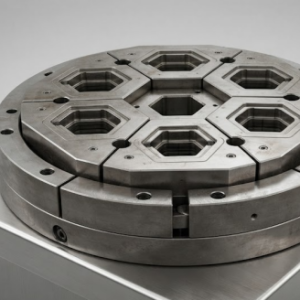
A segmented or split-die configuration provides an alternative approach. The die sections can separate during the appropriate stage of the forming and ejection cycle, reducing mechanical interference between the finished part and the die cavity.
This can provide several potential advantages:
- Better control of part ejection
- Reduced mechanical stress during extraction
- Greater flexibility for complex geometries
- Improved dimensional consistency
- Potentially longer tooling service life
The actual benefits depend on the component design, forming sequence, material, machine parameters, and die construction.
The Importance of Precision in Split-Died Tooling
A split die is only effective when its individual segments work together with extremely high accuracy.
During cold heading, the die experiences substantial compressive and impact forces. If the segments are not properly aligned, uneven loading can develop across the tooling system. This may result in accelerated wear, dimensional variation, surface defects, or premature tooling failure.
For this reason, manufacturing quality is particularly important.
Hongli Technology uses precision machining and controlled heat-treatment processes to produce die segments with accurate geometry and stable mechanical properties.
The alignment of each segment, the quality of the mating surfaces, and the dimensional consistency of the finished cavity all contribute to reliable performance on the production line.
Balancing Hardness and Toughness
Tooling material selection is one of the most important decisions when designing a split die for cold heading.
The material must resist abrasive wear and plastic deformation while also surviving repeated impact and compressive loading. Excessive hardness without sufficient toughness can increase the risk of cracking, while insufficient hardness may result in rapid wear or cavity deformation.
Depending on the application, cold-heading dies may be manufactured from specialized tool steels, high-speed steels, or cemented carbide grades.
The appropriate choice depends on factors such as:
- Workpiece material
- Forming force
- Part geometry
- Production volume
- Required surface finish
- Expected tooling life
- Lubrication conditions
For stainless steel, titanium, and high-tensile alloys, tooling selection becomes particularly important because these materials can generate substantial forming loads and accelerate die wear.
Hongli Technology can evaluate the forming conditions and recommend an appropriate material configuration for specific applications.
Heat Treatment and Precision Grinding
Material selection alone does not determine die performance. Heat treatment and final machining are equally important.
Controlled heat treatment helps establish the hardness and toughness required for the intended forming application. Vacuum heat-treatment processes can provide controlled thermal conditions and help minimize unwanted surface contamination or distortion.
After heat treatment, precision grinding is used to bring the die segments to their required dimensions and surface condition.
For split dies, this process requires particular attention because all segments must ultimately form a consistent cavity when assembled.
A small dimensional error in one segment can affect the overall cavity geometry and produce uneven loading during production.
Applications Across High-Speed Manufacturing
Split dies can be considered for a wide range of cold heading applications where conventional solid dies present ejection or geometry limitations.
Typical applications include:
Automotive Fasteners
Automotive components often require high-strength materials and tight dimensional tolerances. Split-die tooling can provide additional flexibility when producing fasteners with complex head configurations or difficult profiles.
Aerospace Components
Aerospace manufacturing places strong emphasis on repeatability and material integrity. Tooling used for these applications must maintain stable dimensions throughout repeated high-load cycles.
High-Strength Industrial Fasteners
Bolts, screws, pins, and other precision fasteners may require specialized cavity geometries and controlled ejection. Split dies can provide an alternative solution for challenging part designs.
How to Extend Split Die Service Life
Even a high-quality die requires proper maintenance. Tooling performance depends not only on manufacturing quality but also on how the die is installed, operated, lubricated, and inspected.
Check Segment Alignment
Guide pins, bushings, and mating surfaces should be inspected regularly.
Proper alignment ensures that forming forces are distributed evenly across the die segments. Small alignment errors can become more significant as production cycles accumulate.
Routine inspection is particularly important in high-speed production environments.
Maintain Proper Lubrication
Cold heading generates considerable friction and contact pressure.
An appropriate lubricant helps reduce friction between the workpiece and tooling while also assisting with heat management and removal of metal debris.
Lubrication conditions should be monitored rather than treated as a fixed setting. Material type, forming speed, tooling geometry, and production conditions can all influence lubricant requirements.
Use Preventive Inspection
Waiting until a die fails completely can result in unexpected downtime, defective parts, and unnecessary production losses.
A cycle-based inspection program provides a better approach. Tooling can be checked at predetermined production intervals for:
- Micro-cracks
- Abnormal wear
- Chipping
- Cavity deformation
- Alignment problems
- Surface damage
Early detection allows maintenance or replacement to be planned before a minor defect becomes a major production problem.
Choosing a Split Die Manufacturer
For manufacturers considering split dies for cold heading, supplier selection should go beyond price.
A capable tooling manufacturer should understand the relationship between the part geometry, forming sequence, workpiece material, machine capacity, and die construction.
Engineering support is particularly valuable for difficult components. The supplier should be able to discuss material selection, cavity design, heat treatment, dimensional tolerances, and expected operating conditions rather than simply providing a standard die.
Hongli Technology combines tooling engineering with precision manufacturing to develop split dies for demanding cold-heading applications. Its approach focuses on maintaining dimensional accuracy, mechanical strength, segment alignment, and production stability.
Looking Ahead to More Complex Cold Heading
The demand for lighter and stronger components continues to influence metal-forming technology. High-strength alloys and increasingly complicated fastener geometries are pushing conventional tooling closer to its practical limits.
As manufacturers pursue higher production speeds and tighter tolerances, tooling design will remain a critical factor in overall production efficiency.
A well-engineered split die for cold heading can provide manufacturers with greater flexibility when conventional solid dies struggle with complex part extraction or geometry.
By combining appropriate materials, controlled heat treatment, precision grinding, accurate segment alignment, and disciplined maintenance, manufacturers can build a more stable tooling system and reduce avoidable downtime.
For companies producing demanding cold-headed components, Hongli Technology provides precision split-die solutions aimed at bridging the gap between complex part requirements and reliable high-volume production.