


As photovoltaic (PV) manufacturing continues to expand, solar module producers are looking for ways to improve production capacity while keeping equipment investment under control. Refurbished production equipment has become an increasingly practical option, particularly for manufacturers upgrading existing lines or expanding capacity without the capital cost of purchasing completely new machinery.
The Bluemann Refurbished Curing Line is designed for photovoltaic module production and provides a cost-effective solution for thermal processing and controlled module transportation. Professionally refurbished, inspected, and tested before delivery, the equipment is intended to provide reliable performance while integrating into existing PV manufacturing environments.
A Practical Solution for PV Manufacturing
In a solar module production line, curing equipment needs to maintain stable material movement while working continuously alongside other production processes. Mechanical stability, conveying accuracy, speed control, and reliable transmission are therefore important considerations.
Rather than simply purchasing used equipment, manufacturers should evaluate refurbished machinery according to its structural condition, transmission system, control performance, maintenance history, and compatibility with the existing production line.
Bluemann's refurbished curing line is prepared through professional refurbishment and testing, allowing manufacturers to obtain production equipment with controlled investment costs and reduced preparation time.
Rigid Square-Tube Frame for Structural Stability
The equipment uses a welded square-tube frame to provide a solid structural foundation.
A rigid frame helps reduce deformation and excessive vibration during continuous operation. This is particularly important for production equipment that requires consistent conveying and accurate positioning.
A stable mechanical structure can also contribute to longer-term operating reliability by reducing unwanted movement and maintaining alignment between the main components.
For manufacturers evaluating a refurbished curing line for solar module production, structural integrity should be one of the first points to inspect.
PVC Conveyor Surface for Safer Material Handling
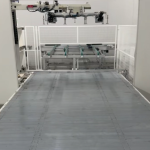
The conveyor incorporates a PVC board surface on the chain plate, providing a smoother contact area for photovoltaic modules.
During module transportation, unnecessary friction, impact, or contact damage can create quality risks. A suitable conveyor surface helps provide controlled material movement while reducing the possibility of scratching or harsh contact with the module surface.
This design is particularly useful when stable and gentle transportation is required between different stages of PV module manufacturing.
Variable-Frequency Speed Control
Production lines do not always operate at the same conveying speed. Different process configurations and production targets may require adjustments to material movement.
The Bluemann refurbished curing line uses a variable-frequency speed-regulating motor, allowing conveying speed to be adjusted according to production requirements.
Variable-frequency control provides greater flexibility when integrating the equipment with other machines in the manufacturing line. It can also help operators achieve smoother material movement rather than relying on a fixed-speed operating configuration.
For a refurbished PV curing line, flexible speed control is an important feature when adapting equipment to different production conditions.
Direct Link Chain Transmission
The curing line uses a link chain transmission with a direct connection between the machine and transmission shaft.
A direct transmission arrangement simplifies power transfer and helps maintain continuous mechanical movement. Reducing unnecessary transmission components can also make the mechanical structure easier to understand and maintain.
Stable power transmission is important for continuous production because irregular movement or excessive vibration can affect material handling and overall line efficiency.
Why Choose Refurbished PV Equipment?
The main advantage of professionally refurbished equipment is the balance between performance and investment.
Compared with purchasing an entirely new curing system, a properly refurbished machine can reduce initial capital expenditure while still providing the mechanical functions required for production.
For manufacturers, several factors make refurbished equipment attractive:
Lower investment cost: A refurbished curing line can provide a more economical alternative to new equipment.
Professional inspection: Proper refurbishment should include mechanical inspection, maintenance, testing, and verification of key components.
Faster deployment: Equipment that has already been refurbished and tested can shorten preparation time before installation.
Existing-line integration: Refurbished equipment can be a practical choice when manufacturers need to expand or upgrade an established PV production line.
However, the actual condition of the equipment remains critical. Buyers should evaluate refurbishment quality rather than making a decision based solely on purchase price.
What Should Buyers Check?
When purchasing a refurbished curing line for PV modules, manufacturers should examine several technical factors.
The frame should be inspected for deformation, corrosion, weld integrity, and alignment. The conveyor should be checked for smooth movement and suitable contact surfaces. Motors, transmission components, chains, shafts, and speed-control systems should be tested under operating conditions.
Compatibility with the existing production line is equally important. Dimensions, conveying direction, production speed, electrical requirements, and interface arrangements should be confirmed before installation.
A professional refurbishment process should ultimately provide buyers with a clear understanding of the equipment's operating condition and readiness for production.
Why Consider Bluemann?
Bluemann focuses on practical equipment solutions for photovoltaic manufacturing.
Its Refurbished Curing Line combines a welded square-tube frame, PVC conveyor surface, variable-frequency speed control, link chain transmission, and direct shaft connection to provide stable material handling for PV module production.
The equipment is professionally refurbished and tested before delivery, making it suitable for manufacturers looking to upgrade or expand production while maintaining control over equipment investment.
For companies evaluating refurbished solar manufacturing equipment, Bluemann offers an option that emphasizes mechanical stability, conveying control, and practical production integration rather than simply providing low-cost used machinery.
Conclusion
Refurbished equipment can play an important role in modern photovoltaic manufacturing, particularly for companies seeking additional capacity or production-line upgrades without the investment associated with completely new machinery.
The Bluemann Refurbished Curing Line combines structural stability, controlled conveying speed, smooth material handling, and reliable transmission in a practical solution for PV module production.
Ultimately, the value of refurbished equipment depends on more than its purchase price. Structural integrity, component condition, speed-control performance, transmission reliability, testing quality, and compatibility with the existing production line should all be considered.
For manufacturers seeking a balance between equipment performance and investment efficiency, a professionally refurbished curing line can provide a practical pathway toward more reliable and cost-conscious PV module production.