
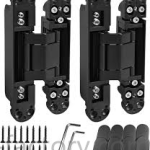

Contemporary architectural design increasingly favors hardware that can provide functional flexibility without becoming a dominant visual element. Modern residences, commercial offices, hotels, and institutional interiors often require precise door alignment alongside clean and uninterrupted surfaces. In these applications, Concealed 3D Adjustable Hinges combine hidden installation with multidirectional adjustment, allowing engineers and installers to address alignment requirements while maintaining a discreet architectural appearance.
Material engineering is fundamental to the development of concealed adjustable hardware. Manufacturers evaluate materials according to structural strength, fatigue resistance, wear behavior, corrosion resistance, and dimensional stability. Suitable alloys can provide the rigidity required for load-bearing components while maintaining practical machinability. Corrosion-resistant material options can also help protect internal parts from environmental influences, especially where doors are exposed to humidity or frequent cleaning.
Material processing directly affects the consistency of finished components. Forming, heat treatment, CNC machining, and surface finishing can influence hardness, structural stability, and dimensional accuracy. Controlled processing helps manufacturers maintain consistent component characteristics throughout production. This is particularly important for adjustable assemblies because multiple internal parts must maintain accurate relationships while allowing controlled movement during installation and subsequent alignment.
Surface engineering provides additional protection for concealed mechanical components. Although much of the mechanism remains hidden after installation, internal surfaces still need to withstand friction, movement, and environmental exposure. Protective finishing technologies can help reduce oxidation and surface deterioration, while precision treatment of contact areas can support smoother interaction between moving components. Consistent surface quality can also contribute to more predictable adjustment during installation.
Precision manufacturing is essential for producing compact assemblies with multiple adjustment functions. CNC machining systems allow manufacturers to create complex structural elements with controlled geometry and repeatable interfaces. Automated inspection equipment can verify dimensional accuracy and surface conditions throughout production. Maintaining tight manufacturing consistency helps ensure that internal components fit together correctly and operate according to their intended mechanical relationships.
Three-dimensional adjustment provides practical value during door installation and alignment. Door structures can experience small positional differences because of construction tolerances, material movement, or installation conditions. A mechanism that permits controlled adjustment across multiple directions gives installers greater flexibility when correcting alignment. This can help improve the relationship between the door leaf and frame while preserving the concealed nature of the hardware.
Structural engineering plays an important role in supporting this flexibility. Engineers must consider how adjustment mechanisms interact with load-bearing components and how forces are distributed during repeated door operation. Computer-aided design and simulation tools can help evaluate these relationships before physical production. By studying stress distribution and component movement digitally, designers can refine structural geometry and reduce unnecessary concentrations of mechanical force.
Different building environments create different installation requirements. Residential interiors may prioritize clean visual integration and comfortable operation. Commercial offices can require consistent alignment across frequently used doors, while hospitality projects may place particular emphasis on refined appearance. Institutional environments can introduce additional demands related to repeated operation and maintenance access. Hardware development must therefore consider both mechanical performance and the practical conditions of installation.
Manufacturing automation supports consistent production of these precision components. Computer-controlled machining provides repeatable processing, while automated inspection systems help identify deviations before final assembly. Digital production management can also improve process monitoring and material utilization. Combining automated manufacturing with experienced engineering helps manufacturers maintain stable quality while producing increasingly sophisticated concealed mechanisms.
Long-term durability is also connected with responsible material and manufacturing choices. Efficient machining processes can reduce unnecessary material waste, while durable components can contribute to longer service lifecycles. Manufacturers can further evaluate surface treatment methods and production workflows to improve resource utilization. These practices help connect precision hardware development with broader sustainability considerations within modern construction.
The continued development of Concealed 3D Adjustable Hinges reflects the integration of material science, precision manufacturing, structural engineering, and architectural design. Lanxi Maya Hardware Co., Ltd. applies these principles to professional hardware development and manufacturing, with additional product information and catalogue resources available through https://www.hinges-factory.com/product/catalogue-download/ for customers evaluating concealed architectural hardware solutions.