


Market Overview
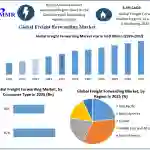
The Freight Forwarding Market was valued at approximately USD 205.74 billion in 2025 and is projected to reach nearly USD 260 billion by 2032, expanding at a CAGR of 3.4% during 2026–2032, according to Maximize Market Research. Freight forwarding is becoming increasingly important as manufacturers, retailers, e-commerce companies, healthcare providers and other industries depend on efficient cross-border movement of goods through air, ocean, rail and road transportation.
The market is being supported by the expansion of international trade agreements, increasing cross-border commerce, rising e-commerce activity, and the growing complexity of global supply chains. Trade agreements such as the Regional Comprehensive Economic Partnership (RCEP) are supporting cross-border trade by reducing tariff barriers and encouraging movement of goods among participating economies. At the same time, artificial intelligence is transforming freight forwarding through automated documentation, predictive analytics, route optimisation, shipment tracking and real-time decision-making. Maximize Market Research identifies AI adoption, rising international air and ocean freight and e-commerce growth as important market drivers.
Another major opportunity is the increasing requirement for supply-chain resilience. Geopolitical tensions, tariff changes, port congestion and changing sourcing strategies are encouraging businesses to diversify suppliers and logistics routes. Freight forwarders that provide integrated customs brokerage, multimodal transportation, warehousing, visibility platforms and value-added services are therefore positioned to capture additional demand. Digital freight platforms and AI-enabled customs solutions are also creating opportunities for faster clearance, lower administrative costs and improved shipment visibility.
United States Market Trends and Investment in 2025
The United States remained a critical market for freight forwarding in 2025, with changing tariff policies creating both challenges and additional demand for customs and forwarding services. U.S. importers increasingly relied on customs brokers to manage rapidly changing tariff requirements, while major logistics providers expanded compliance capabilities and adjusted brokerage fees. The U.S. Department of Transportation also advanced work on its 2025 National Freight Strategic Plan, focusing on freight infrastructure, reliability, resilience, innovation, data and emerging technologies. In April 2025, the U.S. administration also directed the development of a plan for Maritime Prosperity Zones intended to encourage domestic and allied investment in maritime industries and waterfront communities. These developments are expected to increase demand for sophisticated freight forwarding, customs management and multimodal logistics solutions.
Request To Free Sample of This Strategic Report ➤ https://www.maximizemarketresearch.com/request-sample/148362/
Largest Market Segment
By Mode of Transport, Ocean Freight Forwarding dominated the global market with approximately 43% share in 2025. The segment is expected to expand at around 4.5% CAGR during the forecast period. Ocean freight remains dominant because it provides cost-effective transportation for large-volume international shipments and benefits from continued expansion of global trade, port infrastructure, container capacity and e-commerce. Rising air-freight costs also encourage businesses to shift suitable cargo toward ocean transportation.
By Region, North America held the largest share at approximately 32% in 2025. The region benefits from the scale of the U.S. economy, extensive international trade relationships and sophisticated transportation infrastructure.
Competitive Analysis
The freight forwarding industry is highly competitive, with global companies investing in technology, network expansion, customs services and integrated logistics capabilities.
DHL Global Forwarding: DHL is strengthening digital capabilities across its freight forwarding operations. In November 2025, DHL Global Forwarding, Freight introduced an “Accelerated Digitalization” structure focused on scaling digital capabilities, deploying AI-powered solutions and accelerating transformation of service centers. The company is also developing AI-powered customs clearance and digital solutions for small and medium-sized businesses.
DSV: DSV completed its acquisition of Schenker on 30 April 2025 in a transaction valued at approximately EUR 14.3 billion, creating a major global transport and logistics player with close to 160,000 employees across more than 90 countries. DSV expects significant synergies from integrating operations, logistics facilities, back-office functions and IT infrastructure.
Kuehne+Nagel: Kuehne+Nagel continued to emphasize digitalisation and AI in 2025, linking its extensive databases with artificial intelligence to improve operational efficiency and customer services. The company also maintained strong positions in air and sea logistics, supporting its competitive position in international forwarding.
A.P. Moller–Maersk: Maersk continued expanding its integrated logistics strategy, combining ocean transportation with forwarding, landside and logistics services. Its technology initiatives include AI, data science and real-time IoT applications. In 2025, its Bengaluru technology centre showcased Star Connect, an AI-powered fleet energy-efficiency platform processing billions of IoT data points to improve operational decision-making and fuel efficiency.
UPS Supply Chain Solutions: UPS continues to provide international air and ocean freight forwarding, customs brokerage, healthcare logistics and other supply-chain services across more than 200 countries and territories. Its digital businesses are also being used to improve visibility and provide technology-enabled logistics services.
Regional Analysis
United States: The U.S. represents the core of North America's freight-forwarding demand because of its large economy, extensive import-export activity and highly developed logistics network. Government efforts toward freight infrastructure modernization, resilience and innovation are expected to support long-term market development.
Germany: Germany is a major European logistics hub with strong automotive and manufacturing trade. The DSV-Schenker combination is particularly significant for Germany, with DSV planning substantial investment following the acquisition and expanding its European road, air and ocean capabilities.
United Kingdom: The UK's position as a major international trading and logistics center supports continued freight forwarding demand. Cross-border e-commerce, international trade and customs requirements remain important growth factors.
France: France benefits from its strategic position in European trade and its major ports, road networks and connections to continental markets. Demand for multimodal logistics and international freight services supports market growth.
Japan: Japan's export-oriented economy, particularly its automotive and electronics industries, creates consistent demand for international freight forwarding. The country was identified by Maximize Market Research as the world's second-largest car exporter in the cited trade data, reinforcing the importance of freight services to its manufacturing economy.
China: China remains a major global manufacturing and trading hub, generating substantial demand for ocean, air and multimodal forwarding. Growing Asia-Pacific trade and supply-chain diversification are expected to provide further opportunities for freight forwarding companies.
Request To Free Sample of This Strategic Report ➤ https://www.maximizemarketresearch.com/request-sample/148362/
Key Players
1. Agility
2. Bolloré Logistics
3. CEVA Logistics
4. Sinotrans India Private Limited
5. DB Schenker
6. DHL Global Forwarding
7. Imerco
8. Dachser
9. DSV Panalpina A/S
10. Expeditors International
11. Hellmann Worldwide Logistics
12. Kuehne + Nagel International AG
13. MGF (Manitoulin Global Forwarding)
14. Nippon Express Co.
15. UPS Supply Chain Solutions
Conclusion
The global Freight Forwarding Market is entering a period in which digitalisation, AI, supply-chain resilience and integrated logistics will increasingly determine competitive advantage. The market's projected growth to nearly USD 260 billion by 2032 demonstrates the continuing importance of efficient global goods movement. Ocean freight is likely to remain the largest transportation mode, while North America will continue to represent a major regional market.
In our view, the strongest long-term opportunity lies in combining traditional freight forwarding expertise with AI-powered customs clearance, predictive logistics, real-time shipment visibility, automated documentation and multimodal supply-chain platforms. Companies capable of helping customers manage tariffs, geopolitical disruptions, sustainability requirements and increasingly complex international trade regulations will be best positioned for sustained growth. Strategic acquisitions such as DSV's integration of Schenker and technology investments by DHL, Kuehne+Nagel and Maersk demonstrate that scale, digital capability and end-to-end service integration will be central to the industry's next phase of development.
About Maximize Market Research
Maximize Market Research Pvt. Ltd. (MMR) is a global market research and consulting company that provides reliable, data-focused, and practical business insights. The firm serves a wide range of industries, including healthcare, pharmaceuticals, technology, automotive, electronics, chemicals, personal care, and consumer goods. Through market forecasts, competitive analysis, strategic consulting, and industry impact assessments, MMR helps organizations understand changing market conditions, identify growth opportunities, and make informed business decisions for long-term success.
Contact Us
Maximize Market Research Pvt. Ltd.
2nd Floor, Navale IT Park Phase 3
Pune Bangalore Highway, Narhe
Pune, Maharashtra 411041, India
Phone: +91 9607365656
Email: sales@maximizemarketresearch.com