




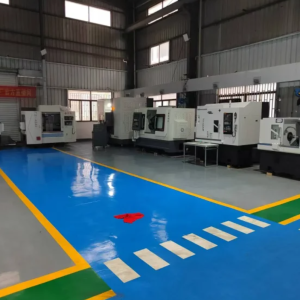

Suzhou machine tool exhibitionCNC, as the core equipment for modern precision processing, its processing accuracy directly determines the quality of the parts and the production efficiency. The negative impact of high-temperature environment on accuracy has long been a common problem in the manufacturing industry, especially in summer or workshops without temperature control facilities. The thermal deformation caused by heat often leads to batch part scrapping and a decline in processing consistency, thereby increasing the hidden production costs.
The core mechanism by which high temperature affects accuracy is uneven thermal deformation. The heat sources of Suzhou machine tool exhibitionCNC are divided into two types: one is internal heat sources, such as the heat generated by the operation of the spindle motor, the friction heat of bearings and guide rails, and the cutting heat during the cutting process; the other is external environmental heat sources, such as the natural radiation of the workshop in summer and the heat dissipation of surrounding equipment. When the environmental temperature rises or fluctuates sharply, the internal and external heat sources work together, causing non-symmetric thermal expansion of the machine tool components - the different thermal expansion coefficients and differences in the heated area further amplify the disorder of deformation. For example, when the temperature rises from 20°C to 40°C, the axial elongation of the spindle can reach 0.02-0.05mm, and the radial runout increases by more than 0.01mm. For parts requiring micrometer-level accuracy, this error is sufficient to cause dimensional deviations.
Specifically in terms of processing performance, the impact of high temperature on accuracy is manifested in multiple dimensions: first, dimensional accuracy deviation. When processing long shaft parts, the bed guideways of the machine tool deform due to temperature gradients, causing the tool feed trajectory to deviate from a straight line, ultimately resulting in increased cylindricity and length dimension errors of the workpiece; industry statistics show that when the workshop temperature exceeds 32°C, the dimensional dispersion of the same model parts is 30%-50% higher than that in a 25°C environment. Second, geometric accuracy deterioration. Thermal deformation of the guideways will destroy the original parallelism, causing the relative position of the cutting tool and the workpiece to shift during cutting, and resulting in a cone or wave pattern on the processed surface; thermal drift of the spindle directly weakens the rotational accuracy, causing the shape and position errors of the parts to exceed the standard. Third, the consistency of batch processing decreases. Day-night temperature differences or uneven temperatures in the workshop will cause the thermal deformation state of the machine tool to be inconsistent at different times, resulting in significant fluctuations in the accuracy of the same batch of parts, and increasing inspection and rework costs.
High temperature also amplifies errors through indirect paths: on the one hand, high temperature reduces the viscosity of lubricating oil, resulting in poor lubrication effects of the guideways and bearings, increased friction resistance, and further generation of additional heat, forming a vicious cycle of "high temperature → lubrication failure → frictional heat generation → deformation intensification"; on the other hand, the accuracy of some old machine tools' sensors may drift due to temperature increase, causing an increase in the execution error of the numerical control system instructions, further weakening the processing stability.
In the field of precision processing, the impact of high temperature on the accuracy of Suzhou machine tool exhibitionCNC cannot be completely eliminated through routine maintenance. In the industry, it is usually alleviated by creating a constant temperature working environment, optimizing the thermal structure design of the machine tool, and adopting the thermal error compensation function of the numerical control system. The thermal deformation-induced accuracy loss is controlled within the allowable range to ensure production stability and product quality.
Suzhou machine tool exhibitionCNC https://www.hexincnclathe.com/participated-in-the-8th-suzhou-international-machine-tool-exhibition.html