

The rapid development of robotics, autonomous systems, spatial computing, and intelligent sensing is accelerating demand for technologies that enable machines to understand and navigate complex environments. Simultaneous Localization and Mapping (SLAM) is becoming increasingly important across warehouses, manufacturing facilities, hospitals, construction sites, defense applications, inspection operations, and autonomous vehicles. Its ability to simultaneously determine location and create maps without relying entirely on fixed infrastructure makes it particularly valuable for indoor and GPS-challenging environments.
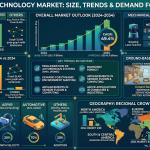
The SLAM Technology Market Size was valued at US$448.61 million in 2025 and is projected to reach US$10,960.26 million by 2034, expanding at a CAGR of 42.63% from 2026 to 2034. The addressable opportunity is estimated at US$35,164.96 million during 2026–2034. North America represented approximately 38–42% of the global market in 2025, while the US accounted for approximately 78–82% of the North American market, positioning the region as a major center for SLAM adoption.
Download Sample PDF Link:
https://www.theinsightpartners.com/sample/TIPRE00009540
North America Emerges as a Key Region for SLAM Technology
North America's strong technology ecosystem, established robotics industry, advanced logistics infrastructure, and high investment in artificial intelligence are creating favorable conditions for SLAM deployment. According to The Insight Partners, North America is projected to grow at a CAGR range of 40–44% between 2026 and 2034. Demand is being supported by warehouse automation, defense robotics, autonomous vehicle software, augmented reality applications, and industrial digital twins.
The region also benefits from strong semiconductor availability, cloud infrastructure, robotics research networks, and enterprise willingness to test advanced automation solutions. Companies are increasingly evaluating navigation technologies based on accuracy, reliability, safety, integration capabilities, and the ability to operate without extensive infrastructure modifications.
US SLAM Technology Adoption Accelerates Through Robotics
The US is expected to remain a major contributor to North America's SLAM technology growth. The country accounted for approximately 78–82% of North America's SLAM technology market in 2025, according to The Insight Partners. Applications include autonomous material handling, fulfillment centers, inspection robots, healthcare logistics, defense systems, UAVs, smart factories, and augmented reality.
The wider US robotics ecosystem provides an important foundation for SLAM adoption. The US autonomous mobile robots industry is being supported by advances in AI, machine learning, sensors, and navigation technologies, while large fulfillment and logistics operations are increasingly deploying autonomous systems.
Warehouse Automation Drives SLAM Demand
Warehouse and logistics automation is one of the strongest drivers for SLAM adoption in North America. Autonomous mobile robots need to move through facilities containing changing inventory, workers, machinery, and temporary obstacles. SLAM allows these robots to create and update maps while continuously determining their position.
In the US, the growing scale of fulfillment centers and omnichannel retail operations is encouraging investment in autonomous systems that can improve throughput and operational flexibility. The broader US autonomous mobile robot sector is projected to reach approximately US$1.87 billion by 2033, demonstrating the expanding ecosystem in which SLAM technologies can be deployed.
LiDAR and Sensor Fusion Strengthen Navigation
LiDAR is another important driver for SLAM technology across North America. LiDAR sensors provide detailed spatial information that can support accurate localization and three-dimensional mapping. North America's LiDAR industry generated approximately US$911.7 million in revenue in 2025 and is projected to reach US$2.12 billion by 2033, according to Grand View Research.
In the US, LiDAR revenue was approximately US$561.8 million in 2025, with applications spanning airborne, terrestrial, mobile, and UAV systems.
The integration of LiDAR with cameras, inertial measurement units, radar, AI, and edge computing is enabling more sophisticated SLAM solutions. Sensor fusion can improve navigation performance in environments where individual sensing technologies may face limitations.
Defense, UAVs, and GPS-Challenging Environments
Defense and aerospace applications represent another opportunity for SLAM technology in the US. Autonomous ground systems, UAVs, inspection platforms, and robotic systems may need to operate in environments where GPS signals are unavailable, unreliable, or intentionally disrupted.
SLAM enables these systems to establish spatial references using onboard sensors. This capability can support navigation, reconnaissance, infrastructure inspection, disaster response, and other applications where conventional positioning technologies may not provide sufficient reliability.
UAV adoption is also expanding across infrastructure inspection, construction, surveying, mining, and emergency-response applications. SLAM can help drones navigate indoor or complex environments while collecting spatial data.
AR, Spatial Computing, and Digital Twins
The North American technology ecosystem is also supporting SLAM applications in augmented reality, virtual reality, spatial computing, and digital twins. SLAM enables digital objects and information to remain accurately positioned relative to physical surroundings.
For US enterprises, these capabilities can support industrial training, remote assistance, facility visualization, construction planning, and asset management. SLAM-enabled reality capture can also help organizations create detailed digital representations of buildings and industrial environments.
Key Players in the SLAM Technology Market
The competitive landscape includes robotics companies, mapping specialists, software developers, sensor providers, and technology platforms. Key players identified by The Insight Partners include:
- Aethon, Inc.
- Clearpath Robotics Inc.
- Dibotics SAS
- GeoSLAM Ltd.
- GESTALT Robotics GmbH
- Google LLC
- KUKA AG
- Morpho, Inc.
- NavVis GmbH
- Wikitude GmbH
These companies participate across autonomous robotics, 3D mapping, spatial computing, industrial automation, healthcare logistics, and reality-capture applications.
Future Outlook for North America and the US
The outlook for SLAM technology in North America is closely connected with the region's transition toward autonomous operations. The next generation of solutions is expected to combine SLAM with AI-based perception, semantic mapping, cloud connectivity, edge computing, sensor fusion, and digital twins.
In the US, demand is expected to extend beyond traditional robotics toward autonomous delivery, warehouse automation, inspection drones, healthcare robots, defense systems, smart manufacturing, and spatial computing. The increasing emphasis on infrastructure-free navigation is particularly relevant as enterprises seek automation systems that can adapt to changing environments without extensive facility modifications.
North America's established robotics and AI ecosystem provides a strong foundation for continued SLAM deployment. As autonomous machines become more capable and enterprises move from pilot projects toward larger operational deployments, localization and mapping are expected to remain essential components of intelligent navigation systems.
About The Insight Partners
The Insight Partners is a global market research and consulting firm providing industry intelligence across technology, healthcare, energy and power, chemicals and materials, manufacturing, and other sectors. Its research combines market analysis, competitive intelligence, technology trends, and strategic insights to help organizations evaluate emerging opportunities.
Contact Us
The Insight Partners
Email: sales@theinsightpartners.com
Phone: +1-646-491-9876
Website: https://www.theinsightpartners.com
Related Reports -
Submarine Fiber Cable Market Demand, Share & Growth by 2034
Aircraft Wiring Harness Market Dynamics and Trends by 2030
SCADA Oil and Gas Market Size, Trends & Growth by 2034