
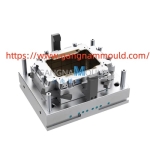

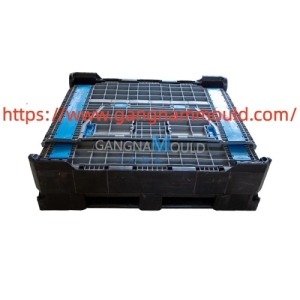
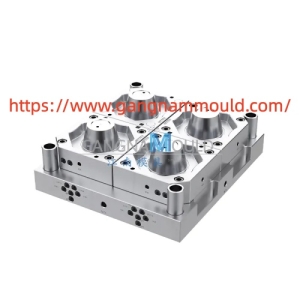
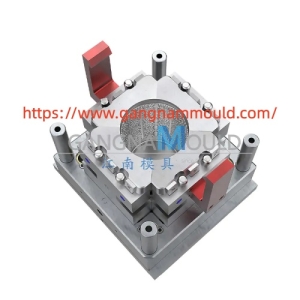
Turnover Box Mould steel selection rests on several practical considerations that production teams review carefully before finalising any design. Hardness stands out as a primary concern because the cavity and core surfaces face repeated contact with molten polymer under high pressure. Prehardened grades in the 30 to 36 HRC range often provide a workable balance for many container projects, offering enough resistance to wear while remaining machinable with standard equipment. Higher hardness values may be specified for areas that experience greater sliding friction, yet excessive hardness can complicate secondary operations and increase the chance of cracking during heat treatment.
Thermal conductivity also plays a clear role. Materials that transfer heat more readily help shorten cooling phases and reduce the risk of warpage in thicker wall sections. Grades containing higher copper content or specialised alloys sometimes appear in inserts placed at hot spots, allowing the main body of the tool to use more economical steel. This combination keeps overall material cost under control without sacrificing cycle consistency.
Expected production volume further influences the decision. Tools intended for several hundred thousand cycles benefit from steels that maintain dimensional stability after prolonged use. Lower volume runs can rely on more affordable options that still meet surface finish and strength targets. Budget constraints naturally enter the picture at this stage. Teams compare unit price against projected tool life, factoring in the cost of any required surface treatments or coatings that extend service intervals.
Geometry of the finished container adds another layer. Deep cavities or complex side actions demand steels with good toughness so that thin sections or sharp corners resist breakage. Surface finish requirements matter as well. Polished areas that contact visible product surfaces call for materials capable of achieving fine finishes with minimal porosity. Corrosion resistance becomes relevant when the polymer contains additives or when cooling water quality varies. In such cases stainless or corrosion resistant grades may be selected for specific inserts even if the bulk of the tool uses standard prehardened stock.
Machining and polishing behaviour complete the evaluation. Steels that cut cleanly and polish uniformly reduce manufacturing time and labour. Consistency of supply from reliable mills also counts, because variation in chemistry can affect hardness response and final performance. Once these factors are weighed, the chosen combination supports reliable daily operation and straightforward maintenance.
Gangnammould applies these same criteria when preparing tooling solutions for clients across logistics and packaging sectors. The approach focuses on matching material properties to the actual demands of each project rather than applying a single formula. Practical testing of candidate steels under simulated conditions often confirms the selection before full scale cutting begins, and detailed specifications for current material pairings suited to different production scales can be reviewed directly at https://www.gangnammould.com/product/