
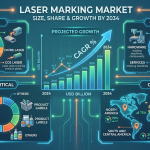

The global Laser Marking Market Size was valued at US$4.01 billion in 2025 and is projected to reach US$6.36 billion by 2034, registering a CAGR of 5.94% during 2026–2034. North America is an important regional market within this growth landscape, with the United States identified as a key country supported by regulatory compliance and traceability requirements, industrial automation, and evolving manufacturing needs. The addressable market is projected at approximately US$48.70 billion during 2026–2034.
Download Sample PDF: https://www.theinsightpartners.com/sample/TIPRE00005606
Regulatory Compliance and Product Traceability
Stringent traceability and product identification requirements are important drivers for laser marking adoption across North America. Manufacturers in the United States increasingly require permanent identification on components and finished products to support quality management, inventory tracking, authentication, and lifecycle monitoring. Laser marking enables manufacturers to create durable serial numbers, barcodes, QR codes, logos, and other identifiers with high precision.
The requirement for reliable product traceability is particularly relevant across automotive, aerospace and defense, medical devices, electronics, and industrial manufacturing. Laser-based systems can be integrated into automated production environments, allowing manufacturers to apply identification codes while maintaining production consistency. The Insight Partners identifies regulatory compliance and traceability requirements as a key driver for the United States laser marking landscape.
US Industrial Automation Accelerates Adoption
The expansion of industrial automation across the United States is creating significant opportunities for laser marking technology. Manufacturers are increasingly integrating automated marking systems with robotics, machine vision, production databases, and manufacturing execution systems. This integration enables marking processes to become part of automated production and quality-control workflows.
US manufacturers are also seeking technologies that can improve production consistency while reducing manual intervention. Laser marking supports high-speed, contactless processing and can be configured for different materials and product geometries. As factories adopt connected manufacturing systems, intelligent marking equipment capable of communicating with other production technologies is gaining relevance.
Automotive and Transportation Industry Drives Demand
The automotive and transportation sector represents an important application area for laser marking across North America. Manufacturers and suppliers use permanent identification for automotive components, assemblies, electrical systems, engine components, and other parts that require traceability throughout production and service lifecycles.
The transition toward electric and increasingly software-driven vehicles is also increasing the number and complexity of electronic and electrical components used in vehicles. This creates additional requirements for precise component identification. Laser marking provides manufacturers with a method of applying detailed markings to relatively small components while maintaining production efficiency.
Aerospace, Defense, and Electronics Applications
The United States has a substantial aerospace and defense manufacturing ecosystem where component identification and traceability are important considerations. Laser marking can support permanent identification of parts, tools, assemblies, and other products exposed to demanding operating environments. Its ability to generate precise and durable markings makes it suitable for applications where identification needs to remain readable throughout extended product lifecycles.
Electrical and electronics manufacturing is another important growth area. The increasing complexity and miniaturization of electronic components are encouraging manufacturers to use precise marking technologies for identification, serialization, and quality management. Fiber, diode, solid-state, and CO2 laser technologies provide options for different material and application requirements. The report covers these laser types across its segmentation framework.
Medical, Healthcare, and Packaging Applications
Medical and healthcare manufacturers across North America are increasingly focused on product identification and traceability. Laser marking can be applied to medical instruments, devices, components, and other products requiring permanent identification. The technology supports detailed markings while minimizing physical contact with the product.
Packaging is another application area where laser marking can provide permanent coding and identification. Manufacturers can use laser systems for product codes, batch information, serialization, and authentication. Increasing attention to supply chain visibility and product verification can further support demand for advanced marking technologies.
Anti-Counterfeiting and Intelligent Marking
The need to strengthen product authentication presents an additional opportunity for laser marking providers in the United States and wider North American region. Manufacturers can incorporate unique codes, serialized identifiers, and specialized markings to help distinguish genuine products from counterfeit goods.
At the same time, intelligent marking systems are becoming increasingly connected with digital manufacturing environments. The Insight Partners highlights a shift toward data-driven marking technologies incorporating artificial intelligence, machine learning, analytics, and automated quality inspection. These capabilities can help optimize marking parameters, verify marking quality, and support production monitoring.
Key Players in the North American Landscape
Key companies profiled in the Laser Marking Market include 600 Group PLC, Coherent, Inc., Epilog Laser, Gravotech Marking, Han's Laser Technology Industry Group Co., Ltd., Jenoptik AG, LaserStar Technologies Corporation, MECCO, Novanta Inc., and TRUMPF GmbH + Co. KG.
The competitive environment in North America is shaped by product innovation, automation capabilities, laser-source development, software integration, customization, and application-specific solutions. Companies are increasingly focused on delivering marking systems that can integrate into automated manufacturing lines and support demanding industrial applications.
Future Outlook for North America
The outlook for laser marking across North America is closely connected with the continued modernization of manufacturing facilities in the United States, increasing demand for traceability, and wider adoption of automated production technologies. Future developments are expected to emphasize intelligent marking, machine vision integration, connected equipment, automated verification, and application-specific laser solutions.
The growing focus on sustainable manufacturing and circular economy practices may also create opportunities for permanent product identification that supports component tracking, product lifecycle management, and recycling processes. As North American manufacturers continue investing in digital and automated production environments, laser marking is expected to remain an important technology for precise identification and traceability.
About The Insight Partners
The Insight Partners is a global market research and consulting firm providing reliable and actionable insights across multiple industries. The company delivers syndicated research reports, customized research, consulting services, and strategic intelligence to help businesses understand industry dynamics, emerging opportunities, competitive developments, and future growth areas.
Contact Us
The Insight Partners
Email: sales@theinsightpartners.com
Phone: +1-646-491-9876
Website: https://www.theinsightpartners.com
Related Reports -
Submarine Fiber Cable Market Demand, Share & Growth by 2034
Automotive HVAC Market Size, Growth & Trends by 2034
Offshore Wind Cable Market Size, Growth & Trends by 2034