
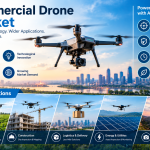




The commercial drone market is becoming an increasingly important part of modern business operations as organizations look for faster, safer, and more flexible ways to collect information and complete tasks. Drones are no longer viewed only as specialized flying devices. They are becoming practical business tools that can support activities across agriculture, construction, infrastructure, logistics, photography, surveying, inspection, environmental monitoring, and security. Their ability to operate from the air provides businesses with a different perspective while reducing the need for traditional approaches that can require significant time, equipment, and manpower.
One of the important concepts supporting this transformation is unmanned aerial vehicle technology, which combines aerial mobility with cameras, sensors, navigation systems, communication capabilities, and specialized software. Commercial users can select drone configurations according to the requirements of their operations. Some businesses may need compact multi-rotor systems for close-range inspection, while others may require fixed-wing platforms for broader-area observation. This flexibility allows drone technology to be adapted to different commercial environments and operational requirements.
Agriculture is an important area where commercial drones can support modern farming practices. Drone-based observation can provide a convenient way to examine fields, identify changes in crop conditions, monitor vegetation, and understand variations across agricultural areas. Instead of relying entirely on ground-based observation, farmers and agricultural service providers can use aerial information to gain a broader view of farmland. Drones can also support targeted agricultural activities where appropriate equipment and operating procedures are available. This creates opportunities for more organized farm management and better use of available resources.
Construction is another sector where drones are changing traditional workflows. Construction teams can use aerial platforms to observe work areas, document project progress, inspect difficult-to-access locations, and support surveying activities. A drone can capture visual information from locations that may otherwise require workers to use additional access equipment. Regular aerial documentation can also help teams compare site conditions over time and communicate project information more effectively. As construction projects become increasingly technology-driven, drones can become part of broader digital workflows that connect field activity with planning and analysis.
Infrastructure inspection is also benefiting from the expanding use of commercial drones. Bridges, buildings, energy infrastructure, communication structures, industrial facilities, and other assets can present challenging inspection environments. Drones can provide visual access to elevated or difficult areas while allowing operators to remain at a safer distance. High-quality cameras and specialized sensors can further improve the information collected during inspection missions. This can help organizations organize maintenance activities and identify areas requiring closer attention.
The logistics sector is exploring commercial drones for delivery and transportation-related applications. Drone delivery can provide an alternative approach for selected routes and specific types of goods. Businesses are examining how aerial transportation can support time-sensitive deliveries, difficult-to-reach locations, and specialized logistics requirements. The development of autonomous flight capabilities and improved navigation systems is helping expand the possibilities for drone-based logistics. However, successful implementation depends on operational planning, airspace requirements, safety procedures, and appropriate infrastructure.
Aerial photography and mapping remain important commercial applications. Real estate companies, media organizations, surveying firms, tourism businesses, and marketing agencies can use drones to create aerial imagery that would otherwise require more complicated equipment. Modern drones can capture detailed views of properties, landscapes, construction sites, and commercial facilities. This visual information can support promotional content, documentation, planning, and analysis.
Technology development continues to influence the commercial drone market. Improvements in flight control, obstacle detection, navigation, imaging, connectivity, battery systems, and automation are helping drones become more useful in professional environments. Artificial intelligence can also support functions such as image analysis, object recognition, route planning, and automated decision assistance. These capabilities can reduce the amount of manual work required during certain drone operations while helping businesses process collected information more efficiently.
At the same time, commercial drone adoption requires careful attention to regulation, privacy, safety, and data management. Businesses need to understand applicable operating requirements and ensure that drone activities are conducted responsibly. Data collected through aerial platforms can also contain sensitive information, making secure storage and controlled access important considerations. Organizations adopting drones therefore need to consider both technological capabilities and operational responsibilities.
The future of the commercial drone market is closely connected with the broader development of automation and digital business processes. As companies seek more efficient ways to inspect assets, gather information, monitor operations, and deliver services, drones can become increasingly integrated with existing technologies. Cloud platforms, artificial intelligence, geographic information systems, analytics tools, and remote-control systems can work together to create connected drone workflows.
Commercial drones are therefore evolving from standalone devices into components of wider business solutions. Their combination of aerial mobility, sensing, automation, and digital connectivity gives organizations new ways to approach operational challenges. As technology becomes more accessible and businesses gain greater familiarity with drone-based workflows, commercial applications are likely to continue expanding across diverse industries.
FAQs
1. What are commercial drones used for?
Commercial drones are used for applications such as aerial photography, surveying, agriculture, construction monitoring, infrastructure inspection, logistics, mapping, environmental observation, and security-related activities.
2. Why are businesses adopting commercial drones?
Businesses adopt commercial drones because they can provide aerial access, improve information collection, support remote inspection, streamline certain workflows, and offer flexible solutions for tasks that may otherwise be difficult or time-consuming.