

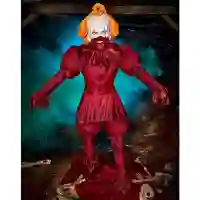
Pennywise is one of horror's most recognizable characters, but there is much more to the terrifying clown than his red balloon, sharp teeth, and creepy smile. The character comes from Stephen King's 1986 novel IT, where a supernatural entity preys on the people of Derry, Maine, especially children.
The character has become even more popular through film adaptations and IT: Welcome to Derry, the HBO series that expands the world established by King's novel and the recent films.
Who Is Pennywise?
Pennywise is the clown-like form most commonly associated with an ancient supernatural entity known simply as IT. The clown appearance is not the entire identity of the creature; it is one of the forms IT uses to frighten and manipulate its victims.
That distinction is important when understanding the story. Calling the creature simply "Pennywise" is common, but the larger threat is IT itself. Pennywise became its most famous appearance because the clown can look friendly enough to attract children before becoming terrifying.
What Is Pennywise's Origin?
Pennywise's origin is connected to the larger mythology of IT, a supernatural being that exists far beyond an ordinary human or monster. Stephen King's novel presents the creature as something ancient that has been living beneath or around Derry and feeding on fear.
The exact mythology is deliberately strange and cosmic rather than being a simple human backstory. This is one reason Pennywise remains different from a traditional slasher villain: the character represents a much larger supernatural threat.
Is Pennywise the Same as IT?
Pennywise and IT are closely connected, but they are not exactly the same thing. IT is the supernatural entity, while Pennywise the Dancing Clown is one of the forms it uses.
This difference explains why the creature can appear in different frightening forms. Pennywise is simply the image that became most strongly associated with the story, particularly because of the character's ability to approach children while appearing like a performer.
Why Does Pennywise Look Like a Clown?
The clown form is effective because it combines something familiar with something disturbing. A clown can attract attention, especially from children, while the exaggerated smile and costume can become frightening when the character's intentions are revealed.
Pennywise's appearance also makes fear part of the character's identity. Instead of relying only on physical strength, IT uses what its victims fear against them, making the horror personal rather than predictable.
What Powers Does Pennywise Have?
Pennywise has supernatural abilities that go far beyond those of a normal human villain. The creature can change its appearance, manipulate perceptions, and use fear as part of its attacks.
Its shapeshifting ability is particularly important because IT can become whatever form is most frightening to a victim. That makes Pennywise difficult to understand as a conventional monster and helps explain why different characters experience different kinds of terror.
Can Pennywise Change Form?
Yes. Shapeshifting is one of the most important aspects of IT's supernatural nature. Pennywise can use different appearances to exploit the fears of its victims.
This is also why the clown should not be viewed as the creature's permanent physical appearance. Pennywise is the iconic face of the horror, but IT's ability to change form is what makes the entity much more dangerous.
Why Does Pennywise Use a Red Balloon?
The red balloon has become one of the strongest visual symbols associated with Pennywise. It creates a strange contrast between something playful and something threatening.
A single red balloon can immediately suggest that Pennywise is nearby, which is why the symbol has become so effective in posters, costumes, Halloween decorations, and fan artwork. It is now almost as recognizable as the clown himself.
Where Does Pennywise Live?
Pennywise is strongly connected with Derry, Maine. In King's story, the town is repeatedly affected by the creature's presence, and its underground spaces become an important part of the horror.
Derry is therefore more than just a background location. It is central to the mythology, the history of the characters, and the recurring appearances of IT.
Why Does Pennywise Target Children?
Children are particularly important to the story because their fears can be powerful, vivid, and personal. IT uses those fears to make itself more frightening and to gain control over its victims.
This also creates one of the story's central contrasts: ordinary childhood experiences become connected to something supernatural and horrifying. The Losers Club must overcome that fear rather than simply defeat a physical monster.
What Is IT: Welcome to Derry About?
IT: Welcome to Derry expands the world of Stephen King's IT and the mythology explored in Andy Muschietti's film adaptations. Stephen King's official site describes the series as an expansion of the vision established by the films.
The series premiered on HBO on October 26, 2025 and explores an earlier period in Derry's history. Stephen King's official site notes that the story begins in 1962, when a family arrives in Derry just as a young boy disappears.
Is Pennywise in IT: Welcome to Derry?
Yes. Pennywise and the larger mythology of IT are central to the series' connection with the IT universe. The show gives fans additional material connected to Derry and the creature's history.
That expansion has also renewed interest in Pennywise's origins, appearance, symbols, and mythology. Official HBO merchandise for the series continues to feature Pennywise imagery, including the red balloon and other character designs.
What Is Pennywise's Weakness?
Pennywise is not simply defeated through physical strength. Fear is a major part of the creature's power, so confronting that fear becomes an important part of resisting IT.
The story therefore treats courage and unity as important weapons. The Losers Club's ability to stand together and challenge the creature is central to the larger conflict rather than relying only on conventional monster-fighting.
Why Is Pennywise So Popular at Halloween?
Pennywise works extremely well for Halloween because his visual identity is immediately recognizable. The clown costume, pale face, red hair, sharp smile, and red balloon can create a complete theme without requiring dozens of accessories.
Fans can also take the idea further with a Pennywise costume, Pennywise mask, red balloons, creepy lighting, and scary Halloween decorations. A Pennywise animatronic can become the centerpiece of a larger porch, haunted-house, or party display.
What Makes a Pennywise Halloween Costume Recognizable?
The most important elements are the clown-inspired outfit, recognizable makeup or mask, dramatic hair, and the character's distinctive expression. The red balloon is an easy extra detail that can instantly reinforce the theme.
For a more complete setup, Halloween Costumes can be combined with IT-inspired Halloween decorations. Red balloons, dark lighting, sewer-inspired details, and simple horror props can create an atmosphere without making the display too crowded.
Why Does Pennywise Remain a Horror Icon?
Pennywise has survived across generations because the character combines a memorable appearance with a much larger supernatural story. The clown is recognizable within seconds, while the mystery surrounding IT gives fans more mythology to explore.
From Stephen King's original novel to the films and IT: Welcome to Derry, the character continues to evolve while keeping the same core idea: a terrifying entity that turns fear itself into a weapon.
Final Question: What Makes Pennywise So Terrifying?
Pennywise is frightening because the character is not simply a scary clown. Behind that familiar appearance is a supernatural entity capable of changing form, manipulating fear, and returning to the same community across different periods of its history.
That combination of mystery, shapeshifting, Derry's dark history, and an instantly recognizable visual identity makes Pennywise one of the strongest horror characters for Halloween, costumes, decorations, and modern horror storytelling.