
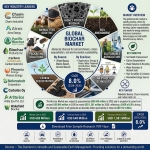


The global biochar market is projected to grow from USD 648 million in 2026 to approximately USD 1.399 billion by 2036, expanding at a compound annual growth rate (CAGR) of 8.0%, according to Fact.MR. Demand is being supported by agricultural efforts to improve soil quality, growing interest in carbon removal, and the conversion of agricultural and forestry waste into useful materials. The market outlook points to an expanding role for biochar across agriculture, environmental management, and emerging industrial applications.
Biochar is a carbon-rich material produced by heating biomass under controlled conditions, commonly through pyrolysis. Its porous structure and carbon stability make it useful for soil improvement, water retention, and selected filtration applications. Producers are also exploring its commercial value through carbon removal projects, where verified carbon storage can create an additional revenue stream alongside physical product sales.
Get detailed market forecasts, competitive benchmarking, and pricing trends: https://www.factmr.com/connectus/sample?flag=S&rep_id=3781
Soil Amendment Remains a Core Demand Driver
Agriculture is central to the biochar market’s development. Farmers facing soil degradation and water stress are exploring inputs that can improve soil structure, support nutrient retention, and help manage moisture. Biochar is used as a soil amendment, although its performance depends on feedstock, production conditions, soil characteristics, and how it is applied.
Demand is also connected to organic and regenerative farming practices. Agricultural users are assessing biochar as part of wider soil-management strategies rather than treating it as a universal replacement for fertilizers. Producers that can provide consistent quality and application guidance may be better positioned to serve commercial farms and agricultural distributors.
Beyond farming, biochar is finding applications in water treatment, animal feed additives, and construction materials. Its adsorption properties can be useful in certain filtration and environmental-remediation applications, while research and product development are expanding interest in engineered biochar for specialized uses.
Carbon Removal Creates a New Commercial Opportunity
Carbon markets are adding another dimension to biochar demand. When produced and managed under appropriate conditions, biochar can store a portion of biomass carbon in a relatively stable form. Projects may generate carbon removal credits when they meet the applicable methodology, monitoring, and verification requirements.
This creates a commercial model that can combine physical biochar sales with revenue from verified carbon removal. However, not every biochar product automatically qualifies for carbon credits. Eligibility depends on project design, feedstock sourcing, production methods, lifecycle emissions, and the requirements of the relevant certification framework.
Fact.MR identifies carbon sequestration, climate-mitigation initiatives, and waste-to-value practices among the factors shaping market expansion. Producers able to demonstrate product quality and credible carbon accounting may be better equipped to compete as buyers place greater emphasis on measurable environmental outcomes.
India and China Support Regional Growth
India is projected to record a 9.5% CAGR through 2036, according to Fact.MR’s country analysis. Its large agricultural base, availability of biomass residues, and growing interest in soil-health management support the country’s growth outlook. Biochar producers can find opportunities in agricultural supply chains where soil improvement and the productive use of organic residues are priorities.
China is forecast to expand at a 8.8% CAGR, supported by biomass availability, carbon-neutrality initiatives, and investment in waste-to-value technologies. The country’s established industrial base also provides opportunities to scale production and develop applications beyond traditional agriculture.
Japan is expected to grow at a 7.2% CAGR, with waste-management capabilities and demand for soil conditioners contributing to market development. In North America, the United States is projected to record a 6.0% CAGR, supported by carbon removal projects and participation in voluntary carbon markets. Germany is forecast to expand at a 5.4% CAGR, reflecting the role of environmental policy and sustainable agricultural practices in the European market.
Production Technology and Feedstock Shape Competition
Biochar production depends on the availability and consistency of biomass feedstock. Agricultural residues, forestry waste, animal manure, and other organic materials can be used, depending on the technology and intended end use. Feedstock characteristics influence production economics as well as the properties of the resulting biochar.
Pyrolysis is a key production technology, alongside gasification and hydrothermal carbonization. Producers must balance output quality, processing costs, energy requirements, and the logistics of collecting and transporting biomass. Regional differences in feedstock availability can therefore influence where production facilities are viable.
Competition is also shifting toward product differentiation. Agricultural customers may prioritize soil performance and moisture retention, while water-treatment users require appropriate adsorption characteristics. Carbon removal buyers need reliable measurement and verification. Suppliers that tailor products to these needs can compete on performance and documented outcomes rather than price alone.
Competitive Landscape
Companies identified by Fact.MR in the biochar market include Charm Industrial, Airex Energy, Pacific Biochar Benefit Corporation, Biochar Products Inc., Carbon Gold Ltd., Phoenix Energy, Carbofex Oy, and Bioforcetech Corporation.
Market participants operate across different parts of the value chain, including biomass conversion, biochar production, agricultural applications, and carbon removal projects. Competitive positioning can depend on access to feedstock, production scale, product consistency, certification capabilities, and relationships with agricultural and industrial buyers.
As the market develops, producers may seek to broaden their portfolios beyond standard soil-amendment products. Engineered grades for filtration and other specialized uses, combined with verified carbon removal services where eligible, offer potential routes to differentiate their offerings.
Market Snapshot
According to Fact.MR, the biochar market was valued at approximately USD 600 million in 2025 and is estimated at USD 648 million in 2026, with forecast growth of 8.0% CAGR through 2036. India leads the country growth outlook at 9.5%, followed by China at 8.8%. Key feedstocks include agricultural waste and forestry residues, while major applications include soil amendment, water treatment, animal feed, and construction materials.
To View Related Reports
https://sportgalax.com/read-blog/25116
https://afgbfh.blogspot.com/2026/10/analgesics-market-growth-outlook-usd.html
About Fact.MR
Fact.MR is a market research and consulting company providing market intelligence, competitive analysis, and forecasting across global industries. Its research covers emerging technologies, evolving consumer trends, industrial developments, and changing business environments. Fact.MR delivers data-driven insights designed to support strategic planning, investment decisions, and market-entry initiatives.