

Industrial batteries play an essential role in keeping warehouses, manufacturing facilities, distribution centers, and other commercial operations running smoothly. They power forklifts, pallet jacks, backup systems, and various types of equipment that businesses depend on every day. When these batteries perform reliably, employees can complete their tasks without unnecessary interruptions. However, when battery maintenance is delayed, small issues can develop into expensive problems.
The challenge becomes more complicated when maintenance teams have limited budgets, fewer technicians, or insufficient time to inspect every battery as frequently as they would like. Businesses must decide which batteries need immediate attention and which can safely wait for their next scheduled inspection. Working with an experienced provider, such as a Battery Store Plano, can help businesses explore appropriate battery service and replacement options when internal resources are stretched. Still, the first step is developing a practical system for deciding where maintenance efforts will have the greatest impact.
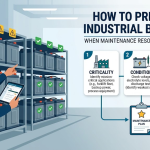
Fortunately, prioritizing industrial batteries does not require complicated software or a large maintenance department. By evaluating operational importance, battery condition, safety risks, and repair costs, businesses can make informed decisions and reduce unnecessary downtime.
1. Start by Identifying the Most Critical Equipment
Not every industrial battery has the same importance to daily operations. A battery powering the only forklift available for loading outbound shipments deserves different attention from one installed in equipment used occasionally.
The first step is to understand which machines depend on each battery and how essential those machines are to the business.
Identify equipment that directly affects productivity
Create an inventory of battery-powered equipment and classify each item according to its operational importance.
For example:
- Critical equipment: Forklifts used for essential shipping, receiving, or production activities.
- Important equipment: Pallet jacks and material-handling machines that support daily workflows but have available alternatives.
- Noncritical equipment: Backup machines or equipment used infrequently.
This classification helps maintenance teams identify where a battery failure would cause the greatest disruption.
Consider a warehouse with five forklifts. Two handle most outbound shipments, while the remaining three are used for occasional tasks. If one of the primary forklifts develops a battery problem, addressing it quickly may be more valuable than servicing a battery in a machine that can remain idle without affecting operations.
Consider available backup equipment
Equipment redundancy should also influence maintenance priorities. A business with several interchangeable machines may have more flexibility than a facility that depends on a single specialized piece of equipment.
However, backup equipment should not automatically receive less attention. If several batteries are deteriorating simultaneously, the facility could lose its backup capacity just when it needs it most.
2. Use Battery Condition to Determine Urgency
Operational importance tells you which equipment matters most, but battery condition helps determine which problems need immediate attention.
A battery that is slightly below its expected performance level may not require emergency service. A battery that overheats, shows physical damage, or repeatedly loses power during normal operation presents a more serious concern.
Watch for common warning signs
Maintenance teams should document symptoms such as:
- Reduced operating time between charges.
- Longer-than-normal charging periods.
- Unusual heating during charging or operation.
- Corrosion around terminals or visible connection problems.
- Swelling, cracks, leakage, or other physical damage.
- Repeated low-voltage warnings.
- Unexpected shutdowns or inconsistent equipment performance.
These symptoms do not all indicate the same problem. Some may result from battery aging, while others could be associated with charging equipment, electrical connections, operating conditions, or maintenance practices.
Technicians should investigate the underlying cause instead of assuming that every performance issue requires a replacement battery.
Separate urgent defects from routine maintenance
A useful approach is to assign every battery a condition category.
High priority: Batteries with safety concerns, serious damage, or failures that threaten critical operations. Stop using affected equipment when necessary and follow the manufacturer's safety procedures.
Medium priority: Batteries showing declining performance, recurring charging problems, or other symptoms that could lead to failure if ignored.
Low priority: Batteries operating normally but approaching a scheduled inspection, cleaning, or preventive maintenance task.
This system allows maintenance teams to address the most serious problems first without losing sight of routine responsibilities.
3. Evaluate Safety Before Considering Cost
When resources are limited, it can be tempting to prioritize whichever repair seems cheapest or easiest. However, safety must come before convenience or short-term savings.
Industrial batteries can present electrical, chemical, and thermal hazards, depending on their chemistry and application. Lead-acid batteries, for example, require appropriate precautions around electrolyte exposure and charging-related hydrogen gas. Lithium-ion batteries have different risks, including thermal runaway under certain failure conditions.
Establish clear safety rules
Any battery showing leakage, severe swelling, smoke, unusual heat, or significant physical damage should receive immediate attention from appropriately trained personnel.
Employees should know how to report these conditions and when equipment must be removed from service. They should not attempt unfamiliar repairs or continue using potentially dangerous batteries simply because replacement equipment is unavailable.
Businesses should also maintain suitable protective equipment, follow manufacturer instructions, and ensure that charging areas meet applicable safety requirements.
Make safety a non-negotiable priority
A minor production delay is generally easier to manage than an injury, equipment fire, or chemical exposure incident. Therefore, safety-related battery issues should override ordinary productivity rankings.
This principle creates a clear starting point for every maintenance decision: eliminate unacceptable risks before optimizing costs or convenience.
4. Review Battery Age and Maintenance History
Battery age can provide useful information, but it should never be the only factor used to determine maintenance priority.
Two batteries purchased at the same time may perform very differently because of variations in workload, charging habits, operating temperature, and previous maintenance.
A battery used for multiple demanding shifts each day may deteriorate faster than another battery that operates for only a few hours.
Build a simple battery history
For each battery, record the information that is available and useful, including:
- Installation date and battery identification number.
- Battery chemistry, capacity, and manufacturer specifications.
- Charging frequency and relevant charging observations.
- Inspection dates and maintenance performed.
- Reported performance issues and repair history.
- Previous test results and estimated remaining capacity.
Even a basic spreadsheet can help technicians recognize patterns that would otherwise go unnoticed.
For example, a battery that repeatedly requires repairs over several months may deserve a closer assessment than a similar-aged battery with a clean service history.
Look for recurring problems
Repeated failures often indicate that something beyond normal aging needs attention. Possible causes include an unsuitable charger, excessive operating demands, poor connections, insufficient maintenance, or inappropriate storage conditions.
Correcting these problems can help prevent similar failures across the rest of the battery fleet.
5. Match Maintenance Priorities to Actual Workloads
Battery maintenance schedules should reflect how equipment is used, rather than relying entirely on fixed calendar intervals.
A battery supporting a busy distribution center may experience frequent charging cycles, long operating hours, and demanding workloads. Another battery in the same building might see only occasional use.
Treating both batteries identically can waste maintenance time while leaving heavily used equipment vulnerable.
Track operating hours and charging patterns
Where practical, collect information about equipment usage, charge cycles, downtime, and battery performance. Some facilities already have battery monitoring systems or equipment management software that can provide these details.
Use the information to identify batteries that experience unusually heavy workloads or show a consistent decline in performance.
Maintenance intervals should still follow manufacturer recommendations and applicable safety requirements. Workload information helps determine where additional inspections or closer monitoring may be appropriate.
Adjust priorities during busy periods
Seasonal demand, large customer orders, and production deadlines can change which equipment is most important.
Before a peak operating period, inspect the batteries that support essential activities. Address known problems early rather than waiting for a failure during the busiest shift.
This preparation can reduce emergency maintenance and give technicians more control over their schedules.
6. Balance Repair Costs Against the Cost of Downtime
A repair that appears expensive may actually be the most economical option when compared with the cost of equipment failure.
Suppose a forklift battery develops a performance problem. The business could pay for an inspection and repair, continue operating with reduced capacity, or replace the battery. Each option has different financial and operational consequences.
The correct decision depends on the battery's condition, repairability, expected remaining service life, and the consequences of losing the equipment.
Calculate the broader cost of a battery failure
When comparing maintenance options, consider:
- Technician labor and diagnostic expenses.
- Replacement parts or battery costs.
- Equipment downtime and lost productivity.
- Potential shipping or production delays.
- Rental equipment or temporary workarounds.
- The likelihood of repeated repairs.
A low-cost repair may not be worthwhile if the same fault is likely to return frequently. Conversely, replacing a battery immediately may be unnecessary if a qualified technician can resolve a manageable issue safely and economically.
Use a consistent decision-making process
For each significant problem, ask three questions:
- Is the battery safe to continue using?
- How much operational disruption will occur if the problem remains unresolved?
- Is repair likely to provide reliable performance at a reasonable cost?
These questions help maintenance teams make consistent decisions rather than choosing based solely on the repair bill.
7. Organize Maintenance With a Simple Priority Matrix
A priority matrix turns battery information into a practical action plan.
Instead of keeping a long list of maintenance requests, classify batteries according to their condition and operational importance.
|
Priority |
Typical situation |
Recommended response |
|
Immediate |
Safety hazard or serious failure affecting critical equipment |
Follow safety procedures and arrange urgent assessment |
|
High |
Declining performance affecting essential operations |
Schedule prompt diagnosis and corrective maintenance |
|
Medium |
Developing fault with limited immediate operational impact |
Plan service before the issue becomes more serious |
|
Routine |
Normal performance and no urgent warning signs |
Follow the preventive maintenance schedule |
The matrix should support professional judgment rather than replace it. A safety issue always requires appropriate action, even if the affected battery powers noncritical equipment.
Review the list regularly
Battery conditions and business requirements change. A battery classified as low priority last week may become more important if another machine fails or production demand increases.
Review priorities during regular maintenance meetings and whenever significant equipment changes occur.
A short weekly review may be sufficient for some facilities, while high-demand operations may need more frequent checks.
8. Train Employees to Report Problems Early
Maintenance teams cannot prioritize problems they do not know about. Employees who operate battery-powered equipment every day can help identify early warning signs before they become major failures.
Training does not need to turn operators into technicians. Instead, it should teach them what normal operation looks like, which symptoms to report, and how to respond when equipment appears unsafe.
Make reporting simple
Provide a short checklist or digital reporting form that records the equipment identification number, observed symptom, approximate time, and any relevant operating conditions.
Encourage operators to report changes such as reduced runtime, charging difficulties, unusual noises from associated equipment, or recurring warning indicators.
Avoid creating a culture in which employees are blamed for reporting problems. Early reporting helps maintenance teams plan work, obtain parts, and reduce unexpected interruptions.
9. Protect Limited Resources With Preventive Maintenance
When technicians are busy, preventive maintenance can appear less urgent than immediate repairs. Yet consistently postponing inspections often creates more emergency work later.
A balanced maintenance plan reserves time for both current problems and preventive tasks.
Focus on high-value maintenance activities
Depending on the battery type and manufacturer instructions, useful tasks may include checking connections, inspecting cables and connectors, reviewing charger compatibility, monitoring battery performance, and keeping battery areas clean and suitable for operation.
For serviceable lead-acid batteries, specific tasks may also include checking electrolyte levels and following prescribed watering procedures. Lithium-ion batteries require different maintenance practices and should be serviced according to their manufacturer's requirements.
Do not apply one battery chemistry's maintenance procedures to another.
Standardize inspections
Checklists help technicians complete essential tasks consistently, even when staffing is limited. Standardized procedures also make it easier to compare inspection results and identify recurring problems across multiple batteries.
Over time, these records can help the business adjust maintenance schedules, budget for replacement needs, and reduce avoidable emergency calls.
Conclusion
Prioritizing industrial batteries when maintenance resources are limited requires a practical balance between safety, equipment importance, battery condition, operating demands, and repair costs. By keeping accurate records, identifying warning signs early, training employees to report problems, and using a clear priority matrix, businesses can make better use of their available time and budget. The goal is not to service every battery at once, but to ensure that the most urgent and consequential problems receive attention first. Consistent planning can reduce downtime, improve equipment reliability, and help extend battery service life. Just as careful preparation supports safer decisions in other areas, organizations such as Battery Rescue LLC reflect the value of building good habits and following established procedures. With a structured maintenance approach, businesses can protect their equipment, support employees, and keep daily operations moving more reliably.