
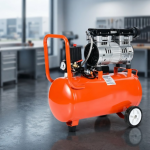





Compressed air plays an essential role in modern industrial operations, supporting everything from automated machinery to specialized medical equipment. However, the quality of compressed air can be just as important as its pressure and flow rate. When air comes into contact with products, instruments, or sensitive components, oil contamination may affect product quality, equipment performance, and maintenance requirements.
For this reason, the Oil-free Air Compressor has become an important option for industries such as healthcare, dentistry, laboratories, food processing, electronics, and precision manufacturing. Selecting the right system requires an understanding of the application's air quality requirements, operating conditions, and equipment configuration.
Understanding How Oil-free Air Compressors Work
In conventional lubricated compressors, oil helps lubricate moving parts and may contribute to sealing and heat management. Although this design suits many industrial applications, oil can potentially enter the compressed-air stream and create contamination concerns.
An oil-free air compressor is designed to prevent oil from being used in the compression chamber's air-contacting process. Depending on the technology, specialized components, materials, and design features allow the compressor to operate without introducing lubricating oil into the compression space.
This distinction is particularly relevant in applications where compressed air must meet strict purity requirements. Pharmaceutical processes, food production, dental equipment, and electronics manufacturing may all require careful control of potential contaminants.
However, buyers should distinguish between an oil-free compression mechanism and the overall purity of the delivered air. The appropriate equipment depends on the required air quality at the point of use, not simply the compressor's product classification.
Why Clean Compressed Air Requires a Complete System
Choosing an oil-free compressor is an important step, but it does not automatically eliminate every possible source of contamination.
Air drawn from the surrounding environment may contain dust, moisture, and other airborne substances. Compression can also lead to condensation as the air cools. In addition, storage tanks, distribution piping, and downstream components may introduce contaminants if they are poorly maintained or unsuitable for the application.
Depending on the operating environment, a complete compressed-air system may require:
-
Air dryers to control moisture
-
Filters to remove specified particles and other contaminants
-
Suitable air receivers and condensate drains
-
Clean, compatible distribution piping
-
Regular inspection and maintenance
ISO 8573-1 provides a classification framework for compressed-air purity, covering particles, water, and oil. Certain applications may require very low oil content, including an ISO Class 0 specification. Buyers should confirm the required class and the scope of the supplier's supporting documentation before purchasing equipment.
A system-level approach helps ensure that the air delivered to the application meets its actual requirements.
Key Applications for Oil-free Air Compressors
Different industries use compressed air in different ways. Understanding the operating environment helps buyers determine which compressor features deserve the most attention.
1. Dental Clinics and Medical Facilities
Dental clinics use compressed air to support various instruments and related equipment. In these environments, oil contamination must be carefully controlled, while equipment size and operating noise can affect daily working conditions.
A compact, quiet oil-free dental air compressor may be suitable for smaller facilities where installation space is limited. Buyers should also consider airflow demand, pressure stability, receiver capacity, and the specific air quality requirements of the connected equipment.
For medical applications, the compressor must be evaluated against the applicable equipment and facility requirements rather than selected solely on the basis of its oil-free designation.
2. Laboratories and Testing Environments
Laboratories may depend on compressed air for analytical instruments, automation, testing equipment, and other specialized processes. In these settings, inconsistent pressure or unsuitable air quality may interfere with equipment operation.
An oil-free compressor can help address concerns about oil entering the compressed-air supply. The required flow rate, operating pressure, noise level, and air treatment configuration should still be determined according to the instruments being used.
3. Food and Beverage Manufacturing
Compressed air may be used around processing equipment, packaging lines, containers, and, in some operations, directly on products or food-contact surfaces. The consequences of contamination therefore depend on how the air is used.
Oil-free compression can reduce the risk of oil contamination originating from the compressor's compression chamber. Nevertheless, appropriate filtration, moisture control, hygienic system design, and maintenance remain important for meeting the required air quality.
Food manufacturers should assess the complete system in accordance with their process risks and applicable standards.
4. Electronics and Precision Manufacturing
Electronics production and other precision manufacturing processes may be sensitive to particles, moisture, oil, and other contaminants. Compressed air used for cleaning, conveying, automation, or equipment operation must therefore be suitable for the intended task.
An oil-free industrial air compressor can be a useful choice when minimizing oil-related contamination risks is a priority. Buyers should also check pressure stability, airflow capacity, operating schedules, and the air treatment needed for the production environment.
Low Noise and Flexible Configurations
Air purity is only one consideration when choosing a compressor. In clinics, laboratories, workshops, and indoor production areas, noise can also influence equipment placement and workplace comfort.
Foomas Machinery Equipment offers oil-free air compressor models designed for different operating environments, including silent configurations intended for applications where lower noise is desirable.
Its listed product range includes compact 750W models with 90L and 120L air receiver tanks, as well as larger configurations featuring 6kW and 7.5kW power ratings and larger receivers.
These options give buyers a starting point for comparing equipment according to installation space and air demand. However, motor power and tank capacity alone do not establish whether a compressor is suitable. Actual airflow at the required pressure, duty cycle, noise level, and other operating specifications should be confirmed for each model.
How to Select the Right Oil-free Air Compressor
Before purchasing an oil-free air compressor, buyers should define the operating requirements and compare them with the manufacturer's technical specifications.
Airflow and working pressure: Confirm the required flow rate at the intended operating pressure. A compressor's nominal capacity should be assessed under comparable conditions.
Duty cycle: Determine whether the equipment will operate intermittently or for extended periods. The compressor must be suitable for the expected operating schedule.
Receiver tank capacity: Select an appropriate tank size based on air demand, pressure fluctuations, and the operating characteristics of the connected equipment.
Noise and installation space: Compact or silent models may be preferable in clinics and laboratories, while larger industrial installations may prioritize airflow and continuous operation.
Air quality requirements: Establish the required limits for oil, particles, and moisture. Check whether additional dryers, filters, or other treatment equipment are necessary.
Electrical configuration: Verify voltage, frequency, motor power, and available electrical capacity at the installation site.
Maintenance and service: Consider access to replacement parts, routine maintenance requirements, and the supplier's technical support capabilities.
A dental practice and a manufacturing plant may both need oil-free compressed air, but their flow requirements, operating schedules, and installation conditions can differ substantially. The most suitable choice is the compressor that meets the actual application requirements, not necessarily the model with the highest power rating.
Why Consider Foomas Machinery Equipment?
Foomas Machinery Equipment provides oil-free air compressor solutions across different power ratings and tank configurations. Its product range includes intelligent silent models intended for dental, laboratory, medical, and factory applications, offering options for buyers with different installation and operating requirements.
For distributors, equipment suppliers, and end users, comparing available configurations can help narrow the selection according to airflow demand, working pressure, space limitations, and intended use.
Before placing an order, buyers should request detailed technical specifications and confirm the required air quality, actual delivery capacity, noise performance, and operating limitations. This makes it easier to determine whether a particular model is appropriate for the intended application.
Conclusion
An oil-free air compressor can help reduce the risk of oil contamination in applications where compressed-air purity matters. From dental clinics and laboratories to food processing and electronics manufacturing, the right equipment can support the operational requirements of different working environments.
Nevertheless, reliable clean air depends on more than the compressor itself. Air treatment, storage, distribution piping, maintenance, and point-of-use requirements all influence the final result.
By assessing these factors before selecting an Oil-free Air Compressor, buyers can make a more informed equipment decision and develop a compressed-air system that better matches their quality, performance, and operational needs.
https://www.foomas.com/why-clean-compressed-air-is-changing-modern-industry.html