



Pile cap foundations are among the most widely used foundation systems in high-rise residential projects worldwide. Their structural integrity and stability directly determine building safety. Across global geotechnical engineering practice, adverse geological conditions—including collapsible loess, soft silty soils, thick layers of artificial fill, and karst formations—are widely distributed across continents. These conditions can easily lead to reduced bearing capacity at pile tips, failure of the coordinated load-bearing system between pile caps and foundation piles, and differential foundation settlement.
Traditional remediation methods generally rely on localized reinforcement. Such approaches not only fail to eliminate settlement at its source but may also cause secondary settlement due to stress concentration. In high-rise residential buildings of 24 stories or more, differential settlement of pile caps can cause wall cracking and the shutdown of supporting facilities, seriously affecting residents’ daily lives. Achieving millimeter-level lifting and repositioning of an entire building’s pile caps without disrupting residents’ occupancy remains a major technical challenge in geotechnical engineering worldwide.
I. Overview of the Patented Technology
The international patent held by Beijing Hengxiang Hongye Foundation Reinforcement Technology Co., Ltd., titled “A Settlement Reinforcement, Lifting and Leveling Structure for Pile Cap Structures and Its Construction Method” (Germany; International Application No.: PCT/CN2019/084388), innovatively introduces a dual-reinforcement approach combining pile cap lifting and leveling with reinforcement and strengthening of the bearing stratum at the pile tips.
The structure integrates piping and lifting components. Its supporting construction method uses layered, directional reinforcement and synchronized lifting operations to establish a complete, coordinated load-bearing system between the pile caps and the underlying pile foundations.
On the one hand, the technology reinforces the weak soil layers beneath the pile caps, forming a large-area composite foundation support system. On the other hand, it strengthens the bearing stratum at the pile tips, ensuring that the loads from the superstructure are transferred evenly to deep, stable geological layers. This simultaneously achieves two key objectives: overall leveling of the pile caps and restoration of pile foundation bearing capacity.
The solution requires minimal construction space and allows work to proceed without disrupting normal building use. It can simultaneously improve foundation bearing capacity and lifting and leveling performance, making it widely applicable to pile foundation reinforcement projects for industrial and civil buildings.
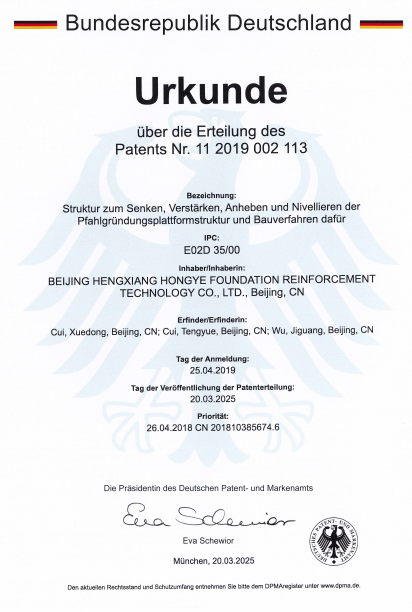
II. Core Advantages of the Patent
Dual Reinforcement to Eliminate Settlement at Its Source
Unlike traditional approaches that focus on reinforcing individual points, this patent adopts a dual-reinforcement strategy combining pile cap strengthening with reinforcement of the bearing stratum at the pile tips. It establishes an integrated reinforcement system extending from the shallow pile cap to the deep bearing stratum at the pile tips, eliminating the risk of secondary settlement and enabling the foundation to achieve its original design service life after remediation.
Integrated Leveling for Precise Structural Alignment
Through coordinated control of layered, directional reinforcement and synchronized lifting, the technology can achieve millimeter-level lifting and repositioning of entire pile caps. It is particularly suitable for correcting the inclination of high-rise residential buildings and for structural lifting and leveling, helping tilted buildings return to a vertical position.
Minimally Invasive Construction Without Disruption
The construction process uses micro-drilling with hole diameters of 10–30 mm, requiring no demolition or resident relocation. Businesses do not need to suspend operations, and construction does not interfere with the normal use of buildings. This approach helps maintain residents’ daily routines throughout the construction process.
Precise Control with Real-Time Monitoring
Equipped with intelligent real-time monitoring systems, the technology provides visualized data throughout the entire construction process. The material setting time and grout diffusion range can be precisely controlled, enabling millimeter-level precision in structural lifting.
Broad Applicability Across Diverse Geological Conditions
The technology is suitable for a wide range of complex geological conditions, including collapsible loess, silty soils, highly filled soils, and karst formations. It can meet the settlement remediation needs of buildings with pile cap foundations across different regions and geological environments.
III. Application Case Study
A 24-story residential building in a residential community in Fujian Province, China, experienced differential settlement, with a maximum settlement of 106 mm. The site featured a composite geological profile consisting of miscellaneous fill, fine sand, silty soil, and completely weathered granite. The building was constructed on a pile cap foundation system. Because the pile tips had not been embedded into the bedrock as required by the design, and the elevation of the top of the weathered bedrock varied across the site, differential foundation settlement occurred.
Combining the patented technology with a non-destructive, controllable soil solidification process, the project implemented coordinated reinforcement of the pile caps and the bearing strata at the pile tips.
Construction involved injecting a new type of specialized composite material into weak soil layers through micro-holes measuring 6–10 mm in diameter. After solidification, the grout formed high-strength soil-grout composites, comprehensively improving the bearing capacity of the deep foundation soils.
Through layered, directional reinforcement and synchronized lifting, supported by intelligent real-time monitoring and comprehensive visualized process control, the project achieved millimeter-level precision in structural lifting. An integrated load-bearing structure was established, extending from the shallow pile caps to the deep bearing strata at the pile tips, effectively eliminating the risk of differential settlement.
The project was successfully completed in just 20 days, achieving an overall lift of 106 mm. Upon completion, all relevant performance indicators met the required standards, and the project passed acceptance inspection on the first attempt.
Feedback from the property owner:
“Throughout construction, residents continued living in the building as usual. There were no water or power interruptions, and no noise or dust disturbances.”
IV. Intellectual Property
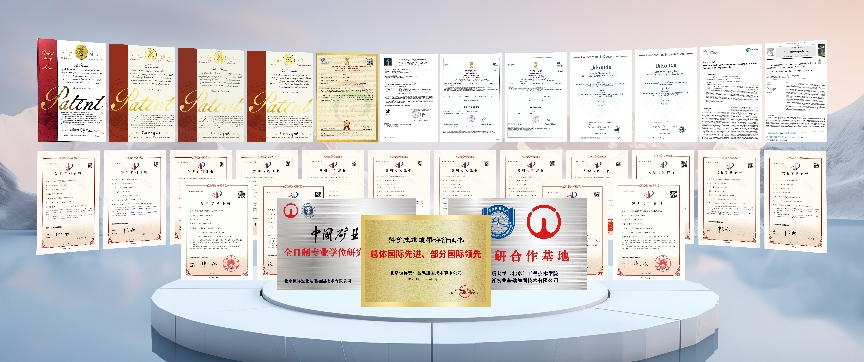
As the holder of this patented technology, Hengxiang Hongye has developed high-rise building lifting and inclination correction technologies that have been evaluated by China’s Ministry of Science and Technology as “internationally advanced overall, with certain aspects reaching an international leading level” (Certification No.: 202311ZK7875). The company has also been recognized as a Beijing Intellectual Property Demonstration Enterprise.
The company has established industry–academia–research partnerships with China University of Geosciences (Beijing) and China University of Mining and Technology (Beijing). To date, it has accumulated a total of 148 domestic and international patent applications and granted patents, including 32 international patents. It has published 14 academic papers, including 9 SCI-indexed papers, and has taken the lead in developing one enterprise standard.
Drawing on 20 years of engineering experience, the company has completed more than 1,000 projects involving building settlement remediation, structural lifting, and inclination correction. With a global service network and overseas branches in place, the company is equipped to provide one-stop services for foundation reinforcement projects both in China and internationally.
V. Conclusion and Future Outlook
Hengxiang Hongye’s independently developed non-destructive, controllable soil solidification technology combines the core advantages of minimally invasive construction, precision, stability, and durability. By integrating overall pile cap leveling with reinforcement and strengthening of the bearing stratum at the pile tips, it provides a comprehensive, root-cause-oriented solution for addressing settlement in the pile foundations of high-rise residential buildings.
Looking ahead, Hengxiang Hongye will continue to deepen international cooperation and advance the development of standards for pile cap reinforcement technologies. Through sustained technological innovation, the company aims to usher in a new era of existing building pile foundation remediation worldwide, characterized by “integrated leveling and root-cause settlement prevention,” safeguarding the structural safety of buildings in cities around the world.