
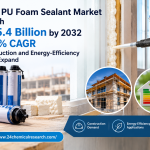


According to 24 Chemical Research, the global PU foam sealant market was valued at USD 2.8 billion in 2024 and is projected to increase from USD 3.1 billion in 2025 to USD 5.4 billion by 2032, exhibiting a CAGR of 7.2% during the forecast period. PU foam sealants are polyurethane-based expanding compounds used for sealing, insulating and bonding applications across construction, automotive and industrial sectors. Their expansion on application helps fill gaps and create airtight seals, while adhesion, thermal insulation and moisture resistance support their use in modern construction.
Read the complete Global PU Foam Sealant Market report: https://www.24chemicalresearch.com/reports/276858/global-pu-foam-sealant-market
PU Foam Sealant Market: A Specialty Sealing Material Supporting Modern Construction
PU foam sealants include one-component, self-expanding formulations and two-component systems mixed before application. Their performance characteristics make them relevant to construction, automotive and industrial applications, while the market is increasingly influenced by energy-efficiency requirements and sustainability considerations.
The report identifies increasing construction activities worldwide, particularly in emerging economies, as a major demand factor. Stricter building energy-efficiency regulations and green-building standards also support adoption because PU foam sealants provide thermal insulation and sealing performance.
What’s Driving PU Foam Sealant Market Growth?
Robust growth in residential, commercial and industrial construction is creating demand for high-performance sealing solutions. Public infrastructure investment and projects requiring weatherproofing, thermal insulation and acoustic dampening provide additional opportunities.
Energy-efficiency and sustainability regulations are another important driver. Building codes and certifications such as LEED and BREEAM emphasize improved thermal insulation, encouraging architects and builders to select materials that can help reduce heating and cooling energy consumption.
Continuous product innovation is expanding the market. Low-VOC, water-blown and fire-retardant formulations address environmental and safety concerns and extend application potential into areas such as HVAC systems and interior finishing.
Production Chemistry and Technology Remain Important
PU foam sealant performance depends on formulation chemistry, application conditions and curing characteristics. The report highlights improved dispensing systems and precision nozzles as application technologies that can increase efficiency and reduce material waste, particularly in industrial applications.
Two-component PU foam is gaining market share because of its curing properties and performance in demanding environments, while one-component formulations remain dominant because of their ease of application and widespread availability.
Download the free sample report: https://www.24chemicalresearch.com/reports/276858/global-pu-foam-sealant-market
Feedstock Economics and Raw-Material Volatility
A significant challenge is fluctuation in the prices of key raw materials, particularly isocyanates such as MDI and TDI and polyols. These petrochemical-derived ingredients are affected by global supply-chain disruptions and crude-oil price instability, directly influencing production costs and manufacturer margins.
Leading companies are responding through supply-chain optimization and regional production. Local manufacturing and diversified supply arrangements can improve availability and reduce logistics costs.
Where Are the Chemical Industry Opportunities?
Rapid urbanization and industrialization in Asia-Pacific, Latin America and the Middle East present significant opportunities as building standards and energy-efficiency requirements develop. Companies can expand distribution networks and introduce region-specific product variants.
Bio-based and recycled-content formulations represent another opportunity. The report highlights PU foam sealants derived from renewable resources such as soybean or castor oil, along with recycled-content formulations aligned with circular-economy concepts.
DIY and retail channels also offer growth potential, especially in North America and Europe, where single-component foam sealants in aerosol cans make the products accessible for small repairs and insulation projects.
PU Foam Sealant Market Segmentation
By type, the market includes One-component and Two-component. One-component formulations dominate because of their ease of application and widespread availability. Two-component systems are gaining traction in industrial applications requiring higher performance.
By application, the report covers Door and Window Installation, Advertising Model, Gardening, Packing and Shipping and Other applications. Door and Window Installation remains the primary application area, supported by construction activity and energy-efficiency requirements.
By end user, the market includes Construction Industry, Manufacturing Sector and Retail & DIY Consumers. Construction accounts for the majority of demand, particularly for insulation and sealing.
By curing time, the market includes Fast-curing, Standard-curing and Slow-curing. By distribution channel, it includes Direct Sales, Retail Stores and E-commerce.
Regional PU Foam Sealant Market Outlook
Asia-Pacific leads market expansion, supported by rapid urbanization, infrastructure development and strong construction activity across China and India. China accounts for over 40% of regional demand according to the report, while Southeast Asia has emerged as a key production base.
North America maintains steady growth through renovation activity and energy-efficiency initiatives. Europe emphasizes sustainable building materials and energy-efficient solutions, with strong adoption in renovation projects. South America is growing through urban development and infrastructure projects, while the Middle East & Africa show varied demand linked to infrastructure development and import dependence.
Competitive Landscape & Key Players
The global PU foam sealant market is characterized by multinational chemical corporations and specialty manufacturers with strong R&D capabilities and distribution networks. Henkel leads the market through its Loctite-branded products, while BASF and Dupont leverage polyurethane expertise. RPM International and Soudal maintain strong regional positions, and ICP Group is gaining traction in niche energy-efficient construction applications.
The report profiles Henkel, RPM International, Soudal, ICP Group, Dupont, BASF, Huntsman and Saint-Gobain. Competition is increasingly influenced by sustainable formulations, product innovation, application technologies and supply-chain optimization.
Challenges Facing PU Foam Sealant Manufacturers
Raw-material price volatility remains a principal challenge. Proper application also requires attention to surface preparation, humidity and temperature, creating a need for skilled labor and training. Environmental and health concerns related to certain blowing agents and isocyanate exposure require regulatory compliance and appropriate protective equipment.
Competition from alternative sealing and insulation technologies, including silicone sealants, acrylics, fiberglass and mineral wool, can limit market share in some applications. Adoption in developing regions can also be constrained by awareness, upfront costs and distribution infrastructure.
What Does the PU Foam Sealant Market Report Cover?
The report provides analysis of sales, sales volume and revenue forecasts, segmentation by type and application, company profiles, product specifications, production capacity and sales, revenue, pricing, gross margins and sales performance. It also examines regional consumption, value, exports and imports, trade balance, market size and CAGR, demand by application and type, price by type and capacity, production, utilization, ex-factory price, revenue, cost and gross margin.
Key Questions Answered by the Study
What is the current global PU Foam Sealant Market size?
How rapidly is the market expected to grow through 2032?
Which PU foam sealant type dominates?
Which application generates the strongest demand?
What are the major raw-material challenges?
Which region leads market expansion?
What opportunities exist for bio-based and recycled-content formulations?
Which companies are profiled in the competitive landscape?
Explore the complete PU Foam Sealant Market analysis: https://www.24chemicalresearch.com/reports/276858/global-pu-foam-sealant-market
Discover key trends, download the report now: https://www.24chemicalresearch.com/reports/276858/global-pu-foam-sealant-market
About 24 Chemical Research
24 Chemical Research specializes in chemical and materials market intelligence, covering specialty chemicals, polymers, surfactants, advanced materials and related industrial markets. Its research combines market sizing and forecasting with analysis of production, capacity, pricing, trade flows, applications, suppliers, regional demand and competitive positioning.
Contact 24 Chemical Research
Phone: +91 9169162030
Email: help@24chemicalresearch.com
Website: www.24chemicalresearch.com