

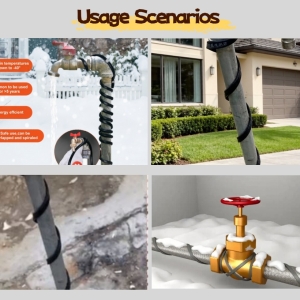




Pipelines carrying water, fire suppression fluid, oil and chemical media face huge risks in freezing weather. When liquid inside a pipeline freezes, water expands and creates massive internal pressure. This pressure cracks pipes, breaks valves, bursts joints and shuts down whole systems. Burst pipelines lead to expensive water damage, production shutdown, safety hazards and high repair bills. Insulation alone cannot always protect pipelines during long periods of sub-zero temperature, especially for exposed outdoor pipes, pipes in unheated basements, remote farm pipelines and emergency fire lines. Pipe heating cable, also known as trace heating cable, is the most widely adopted active freeze protection solution for all kinds of piping systems. This comprehensive guide explains how pipe heating cable works, different types, installation rules, control options, application cases and how to source high-quality trace heating products from a trusted manufacturer.
To begin with, pipe heating cable is an electric heating product wrapped along the outer surface of pipes, valves, pumps and instrument bodies. It supplies steady heat to compensate heat loss from the pipe wall to cold ambient air. Combined with thermal insulation foam or mineral wool covering the cable and pipe, it keeps the internal medium temperature above freezing point or maintains a required process temperature. Trace heating is not only for anti-freeze. In industrial settings, it can maintain viscosity for heavy oil, asphalt and chemical liquids that become too thick to flow at low temperature.
There are two primary types of pipe heating cable: self-regulating heating cable and constant power heating cable. Self-regulating pipe heating cable is the most popular option for general freeze protection. Its conductive core adjusts power output automatically: colder surroundings trigger higher heat output, warmer conditions reduce power draw. This inherent feature makes self-regulating cable safer. It can touch or cross itself without hot spots, which simplifies installation around valves, flanges and complex pipe fittings. Self-regulating cable is available for ordinary wet environments and ATEX explosive hazardous zones. Constant power pipe heating cable releases fixed wattage per meter along the entire length. It delivers stable heat output and suits long pipeline runs or process temperature maintenance that requires precise heat load. Unlike self-regulating versions, constant power cables cannot overlap, and they need stricter temperature control to avoid overheating.
Many customers new to trace heating confuse pipe heating cable with gutter heating cable or snow melting cable. Although they are all electric heating cables, their engineering design targets separate working conditions. gutter heating cable is optimized for open-air exposure, UV resistance and intermittent ice-melting cycles inside gutters and downspouts. Snow melting cable is constructed for burial under concrete or asphalt, with strong compression resistance and alkaline resistance. Using the wrong cable type will shorten lifespan and may void safety certification.
A complete trace heating system is more than just the heating cable itself. A full package includes heating cable, connection kits, end termination kits, T-splice kits, fixing tapes, aluminium foil tape, temperature controllers, pipe sensors and thermal insulation. The controller is the brain of the system. Basic thermostats switch power on and off according to pipe surface temperature. Advanced digital controllers have alarm functions, data recording and remote signal output for building management systems. For unmanned sites, intelligent controllers can send fault alerts, helping maintenance teams discover cable damage or power failure early before pipe bursting occurs.
Installation standards directly decide system reliability. First, clean the pipe surface before attaching the cable. Use aluminium foil tape to improve heat transfer between cable and pipe wall. Secure the cable along the bottom side of water pipes, where liquid gathers and freezing starts first. Wrap cable evenly around valves and flanges, because these fittings lose heat faster than straight pipe sections. Do not stretch the cable beyond its minimum bending radius. Do not crush the cable with sharp edges of insulation materials. After fixing the cable, test insulation resistance before covering with thermal insulation. A final electrical test is required after installation and before the cold season arrives. All installation work for explosion-proof trace heating systems must follow local hazardous area codes.
When sourcing pipe heating cable, selecting a reliable Floor heating manufacturer that also produces industrial trace heating products saves you much time and risk. Floor heating manufacturer Anhui Youyu Electric Heating Equipment Co., Ltd is an innovative high-tech enterprise established in 2012 in Wuhu, Anhui Province. The factory covers more than 20,000 square meters and holds independent intellectual property rights. The company specializes in research, manufacturing, engineering design and construction of electric heating systems. Its product range covers self-limiting temperature cables, constant power cables, heating accessories and intelligent control systems. The company has obtained EAC, CE, ROHS, ATEX, ISO9001, ISO14001 and OHSAS18001 certificates. These certifications support export trade to Europe, Russia, Central Asia and other overseas markets. The engineering team designs customized trace heating schemes for water pipelines, fire protection pipelines, oil pipelines and industrial process piping. The company serves wholesalers, engineering contractors, facility management companies and end users. The business philosophy focuses on user experience and cost-effective customized solutions.
What is the expected service life of qualified pipe heating cable? Properly installed and protected trace heating cables can run reliably for 15–20 years. The main failure triggers are mechanical damage during installation, water entering connection boxes, overheating caused by mismatched controllers, chemical corrosion and UV damage on unprotected outer jackets. That is why purchasing matched original accessories together with the cable is strongly recommended. Mixing generic low-quality splice kits with premium heating cables creates weak points in the whole system.
Routine maintenance for trace heating systems is straightforward. Carry out an inspection before every winter. Check for cracked outer jackets, loose connections and damaged insulation. Run insulation resistance testing periodically as required by local electrical regulations. Clear obstacles around temperature sensors so they can read accurate pipe surface temperature. If a section of cable is damaged, replace that section rather than connecting broken cable directly.
Many projects combine multiple heating needs at the same site. A factory may need pipe heating cable for process pipelines, electric heating mats for floors for office underfloor heating, gutter heating cable for roof ice prevention and snow melting cable for loading ramps. Sourcing all these products from one factory like Anhui Youyu unifies quality standards, simplifies document preparation for customs and project approval, and gets bundled order advantages.
If you are looking for a stable supplier of trace heating and electric heating products, Anhui Youyu welcomes inquiries from all over the world. Share your pipe diameter, pipe material, medium type, minimum ambient temperature, required maintain temperature, hazardous area classification and voltage standard. The technical team will calculate heat loss, recommend suitable pipe heating cable model and provide installation suggestions. With strict quality control and thoughtful after-sales service, Youyu builds long-term win-win partnerships with global clients.