
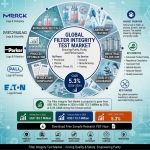

The global filter integrity test market is estimated at USD 103.7 million in 2026 and is projected to reach USD 173.7 million by 2036, expanding at a compound annual growth rate (CAGR) of 5.3%, according to Fact.MR. The market is expected to create an absolute dollar opportunity of USD 70.1 million over the forecast period. Increasing pharmaceutical manufacturing activity, expanding biopharmaceutical production, and regulatory emphasis on sterile filtration validation are supporting demand for specialized testing equipment.
Filter integrity testing helps manufacturers verify that filtration systems perform as intended and maintain the required level of filtration performance. These tests are particularly important in sterile drug production, where compromised filters can affect product quality and patient safety. Pharmaceutical companies are therefore incorporating integrity testing into quality control and manufacturing validation procedures.
Get detailed market forecasts, competitive benchmarking, and pricing trends: https://www.factmr.com/connectus/sample?flag=S&rep_id=11543
Bubble Point Test Systems Lead Product Demand
Bubble point test systems are projected to account for 41% of the product segment in 2026, maintaining their position as the leading product category. These systems help manufacturers assess filter membrane integrity by identifying the pressure at which gas displaces liquid from the largest pores in a wetted membrane.
Pharmaceutical manufacturing is expected to represent 54% of application demand in 2026. The segment's leading position reflects the extensive use of sterile filtration in injectable drug production, biologics manufacturing, and aseptic processing. Pharmaceutical companies are projected to account for 47% of end-use demand, supported by recurring testing requirements and established quality-control procedures.
Diffusion test systems and water intrusion test systems serve additional filtration validation requirements. Manufacturers are also adopting automated integrity testing instruments to improve testing consistency, documentation, and operational efficiency. Digital validation systems and pressure-based monitoring technologies offer further opportunities as production facilities strengthen quality assurance processes.
Regional Outlook: India and China Lead Growth
India is projected to record the fastest country-level growth, with a CAGR of 6.1% through 2036. Expanding pharmaceutical manufacturing infrastructure, rising institutional demand, and growing adoption of quality-control procedures are supporting the country's market outlook.
China is expected to follow at 5.9% CAGR, while the United States is projected to grow at 5.7%. Germany and the United Kingdom are forecast to register CAGRs of 5.5% and 5.4%, respectively. Japan and Brazil are expected to expand at 5.3%.
North America remains the largest regional market, supported by established pharmaceutical manufacturing infrastructure, regulatory frameworks, and institutional procurement networks. Asia Pacific is emerging as a growth area as pharmaceutical production capacity and quality-control investments expand.
Analyst Perspective
Shambhu Nath Jha, Principal Consultant at Fact.MR, says, “The filter integrity test market is structurally evolving from a product-led market toward one where supply chain positioning, regulatory compliance, and distribution reach determine competitive outcomes. Buyers are consolidating procurement around suppliers that can guarantee consistent quality, meet certification requirements, and maintain supply continuity across multiple geographies. The margin structure favors manufacturers with vertically integrated operations and established relationships with institutional purchasers. Companies that rely solely on product differentiation without building distribution and compliance capabilities will find it increasingly difficult to maintain market position.”
Competitive Landscape
The filter integrity test market features established filtration, pharmaceutical equipment, and laboratory technology companies competing through product portfolios, technical capabilities, regulatory compliance, and distribution networks. Key participants include Merck KGaA, Sartorius AG, Parker Hannifin Corp., PALL Corporation, Donaldson Company Inc., Thermo Fisher Scientific Inc., Meissner Filtration Products Inc., Pentair Ltd., 3M, Emerson Electric Co., Alfa Laval, Eaton Corporation plc, GEA Group AG, and SPX FLOW Inc.
Companies are focusing on automated testing systems, improved instrument performance, and solutions that support validated pharmaceutical manufacturing processes. Strong technical support, documentation capabilities, and established relationships with pharmaceutical manufacturers are important competitive differentiators.
Market Snapshot
- Market value (2025): USD 98.4 million
- Market value (2026): USD 103.7 million
- Forecast value (2036): USD 173.7 million
- CAGR (2026–2036): 5.3%
- Absolute dollar opportunity: USD 70.1 million
- Leading product segment: Bubble Point Test Systems (41% share in 2026)
- Leading application: Pharmaceutical Manufacturing (54% share in 2026)
- Leading end user: Pharmaceutical Companies (47% share in 2026)
- Fastest-growing country: India (6.1% CAGR)
To View Related Reports
https://social.art-inpa.com/blogs/42424/Crane-Market-Growth-Trajectory-Points-to-USD-66-7-Billion
https://sportgalax.com/read-blog/26539
https://afgbfh.blogspot.com/2026/10/crane-market-heads-toward-usd-667.html
About Fact.MR
Fact.MR is a market research and competitive intelligence provider delivering market intelligence, competitive analysis, and forecasting across global industries. Its research helps businesses evaluate market demand, understand competitive developments, and identify growth opportunities.