
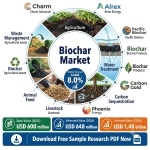

The biochar market is projected to grow at 8.0% CAGR through 2036, driven by sustainable agriculture, soil restoration, and rising demand for carbon removal solutions.
October 31, 2026 — The global biochar market is projected to increase from USD 648 million in 2026 to approximately USD 1.40 billion by 2036, expanding at a compound annual growth rate (CAGR) of 8.0% during the forecast period, according to Fact.MR. The market was valued at USD 600 million in 2025 and is expected to generate an additional USD 742 million in revenue over the next decade.
Rising concerns about declining soil fertility and carbon emissions are changing the commercial outlook for biochar. Agricultural producers are increasingly exploring carbon-rich soil amendments to improve water retention and nutrient availability. At the same time, carbon removal initiatives are creating additional commercial opportunities beyond conventional agricultural applications.
Get detailed market forecasts, competitive benchmarking, and pricing trends: https://www.factmr.com/connectus/sample?flag=S&rep_id=3781
Biochar Market Growth Driven by Sustainable Agriculture and Carbon Removal
The biochar market is gaining attention as governments and agricultural stakeholders place greater emphasis on soil regeneration and climate mitigation. Biochar, produced through the thermochemical conversion of biomass, offers a way to utilize agricultural residues while supporting long-term carbon storage.
Demand is particularly relevant in agricultural economies facing soil degradation and water stress. Farmers are evaluating biochar for its ability to improve soil structure, support nutrient retention, and maintain moisture across growing cycles. These benefits are encouraging interest in regenerative agriculture and organic farming practices.
Government-backed soil health initiatives and emerging carbon credit frameworks are adding another dimension to demand. Biochar is increasingly being considered within negative-emission strategies because its stable carbon content can remain stored for extended periods.
Market Fact Sheet
- Biochar Market Value (2025): USD 600 million
- Biochar Market Value (2026): USD 648 million
- Biochar Market Forecast (2036): USD 1.40 billion
- Forecast CAGR (2026–2036): 8.0%
- Absolute Dollar Opportunity: USD 742 million
- Market Growth Multiple: Approximately 2.2x
Source: Fact.MR analysis, updated April 8, 2026.
India Leads Country-Level Growth in the Biochar Market
India is projected to register the fastest growth among the highlighted countries, with demand expected to expand at a CAGR of 9.5% through 2036. Government-led soil health initiatives, increasing organic farming activity, and growing awareness of carbon sequestration are supporting the country's market outlook.
India's extensive agricultural base also provides access to biomass feedstock, including agricultural residues. This availability creates opportunities for decentralized biochar production, particularly through smaller-scale pyrolysis facilities located closer to biomass sources.
China is expected to record an 8.8% CAGR through 2036. The country's carbon neutrality objectives, biomass availability, and investments in pyrolysis infrastructure are supporting wider adoption. Circular economy initiatives are also encouraging the conversion of agricultural and forestry waste into useful carbon-rich materials.
Japan's biochar market is forecast to expand at 7.2% CAGR. Advanced waste management systems and improvements in biomass processing technologies are supporting demand for specialized soil conditioners.
Other markets are also progressing. Canada is projected to grow at 7.2%, while the United States is expected to register 6.0% CAGR. Germany is forecast to expand at 5.4% during the same period.
Carbon Credit Economics Create New Commercial Opportunities
Biochar's commercial value is increasingly influenced by carbon removal markets. Unlike conventional agricultural inputs, biochar can generate value through both physical product sales and verified carbon sequestration.
Fact.MR's analysis indicates that high-integrity biochar carbon credits reached approximately USD 164 per tonne in 2025, compared with USD 131 per tonne in 2023. During late 2025 and early 2026, indicative credit prices ranged from USD 100 to USD 250 per tonne, depending on certification methodology and the characteristics of sequestered carbon.
Physical product pricing varies considerably by geography. Bulk agricultural-grade biochar in the United States and Europe generally costs between USD 600 and USD 1,500 per metric tonne. In Asia Pacific, including India, prices range from USD 250 to USD 500 per tonne.
An important market detail is that Asia Pacific accounted for approximately 83% of the biochar segment in 2025, according to the supplied Fact.MR analysis. Abundant agricultural residues and modular production systems help explain the region's comparatively lower production costs.
Long-term corporate procurement agreements may also influence future supply conditions. The analysis identifies agreements involving Microsoft and biochar providers as an emerging factor behind potential supply tightness in 2026.
Technology and Application Diversification Shape Competition
Pyrolysis remains a central production technology, alongside gasification and hydrothermal carbonization. Improvements in processing systems are helping manufacturers explore different feedstocks and customize biochar characteristics for specific applications.
Agriculture remains an important demand area. However, water treatment, animal feed additives, waste management, and construction materials are creating additional opportunities. Product characteristics such as porosity, carbon content, and surface area influence suitability across these applications.
Competition is also moving beyond basic product pricing. Institutional buyers and large-scale farmers are increasingly evaluating measurable soil improvements and carbon sequestration potential. Fact.MR's analysis estimates that approximately 30% to 40% of these buyers prioritize performance outcomes over initial purchase costs.
Producers offering application-specific formulations and carbon certification services may therefore gain a stronger commercial position. Integrated services covering lifecycle impact assessment and agronomic support are estimated to improve margins by 15% to 25% compared with standalone product sales.
Key Companies Focus on Production Expansion and Carbon Certification
The competitive landscape includes specialized climate technology businesses and biomass processing companies. Leading participants include Charm Industrial, Airex Energy, Pacific Biochar Benefit Corporation, Biochar Products Inc., Carbon Gold Ltd., and Phoenix Energy.
Recent developments indicate growing industrial interest. In June 2025, Airex Energy inaugurated a large-scale biochar production facility in Canada in partnership with SUEZ. The broader development roadmap targets approximately 350,000 tonnes of annual biochar production capacity globally.
In January 2026, CHAR Technologies reported progress on its Espanola biocarbon project in Ontario. Project partner BMI Group reaffirmed an investment commitment of approximately USD 10 million to support development.
These investments reflect an expanding focus on commercial-scale production. Companies are also exploring decentralized facilities and secured biomass sourcing agreements to manage feedstock availability and transportation expenses.
View Related Reports :
https://social.mytamam.com/blogs/841/Mining-Lubricants-Market-to-Reach-USD-5-45-Billion-by
https://ayushjadhavblogs.blogspot.com/2026/10/global-chemical-depolymerization-market.html
https://uddokta64.com/blogs/14962/Digital-PID-Control-and-Automation-Shape-the-Future-of-the
https://gulfsena.com/blogs/112090/Passenger-Cars-to-Account-for-60-of-Global-Automotive-Actuator
Fact.MR's Analysis of the Biochar Market
Fact.MR is a market research and consulting firm that provides market intelligence, industry forecasts, and strategic analysis to support business decisions.
The biochar market report evaluates industry performance from 2025 to 2036, covering feedstock types, production technologies, applications, regional developments, pricing trends, and competitive strategies. The assessment incorporates primary interviews, secondary research, and quantitative forecasting models.
The analysis also examines how agricultural demand, biomass availability, carbon credit mechanisms, and technological developments influence market opportunities across major economies.