
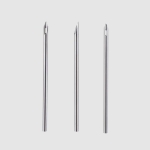





The growing demand for accuracy and consistency in healthcare manufacturing has brought Solid Medical Needles and Stainless Steel Capillaries into sharper focus. These components play a quiet yet essential role in diagnostic, therapeutic, and laboratory environments, where dimensional stability and material reliability matter more than visual complexity. Their performance is often defined not by novelty, but by how well they integrate into demanding workflows that require repeatable outcomes and dependable material behavior.
Solid medical needles are typically manufactured as single-piece metal structures, avoiding internal seams or layered construction. This structural integrity contributes to predictable mechanical behavior during use, especially in applications that require controlled penetration or stable fluid guidance. Stainless steel capillaries, on the other hand, are designed with precisely controlled inner and outer diameters, enabling them to guide liquids or gases with minimal variation. When used together, these two products support a wide range of medical and laboratory processes that depend on accuracy rather than force.
Material selection plays a central role in the functionality of both components. Medical-grade stainless steel is commonly chosen due to its balance of corrosion resistance, machinability, and mechanical stability. This material performs consistently across a range of temperatures and environments, making it suitable for repeated sterilization cycles. The absence of coatings in many solid needles and capillaries also reduces the risk of material interaction during sensitive procedures, helping maintain a stable interface with surrounding equipment or fluids.
Manufacturing precision is another defining characteristic. Solid medical needles require tightly controlled grinding and polishing processes to ensure smooth external surfaces and consistent tip geometry. Any variation can influence insertion behavior or alignment with connected devices. Similarly, stainless steel capillaries rely on advanced drawing and finishing techniques to achieve uniform wall thickness. This uniformity supports predictable flow behavior, which is particularly relevant in diagnostic systems and analytical instruments.
From a functional perspective, solid needles are valued for their structural strength. Their rigidity allows them to maintain alignment during use, reducing the likelihood of bending or deformation under normal operating conditions. This is especially relevant in automated or semi-automated medical equipment, where mechanical consistency is essential for reliable operation. Stainless steel capillaries complement this by offering controlled internal pathways that support accurate fluid transfer without introducing unnecessary resistance.
Surface quality is often an overlooked aspect, yet it directly affects performance. Polished surfaces on both needles and capillaries help reduce friction and minimize material buildup. This characteristic supports smoother operation and can simplify cleaning or sterilization processes. Rather than relying on additional treatments, manufacturers often focus on refining mechanical finishing steps to achieve the desired surface characteristics naturally.
Another important consideration is dimensional customization. Medical and laboratory equipment varies widely in design, and standardized components do not always meet specific integration needs. Solid medical needles and stainless steel capillaries can be produced in a broad range of diameters, lengths, and tolerances. This flexibility allows manufacturers to tailor components to particular devices without altering the overall system architecture.