
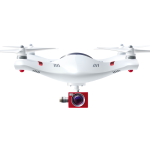


The Drone Camera Market is a dynamic part of the broader aerial imaging, unmanned systems, and digital inspection ecosystem, built around camera payloads and integrated imaging systems used for photography, videography, mapping, inspection, surveillance, public safety, agriculture, and industrial intelligence. The market is no longer defined only by consumer aerial photography. It is increasingly shaped by multi-sensor payloads, thermal imaging, zoom capability, laser rangefinding, RTK-enabled mapping, autonomous inspection workflows, and dock-based remote operations. From 2026 to 2034, market momentum is expected to be driven by demand for richer aerial data, safer remote inspections, higher-resolution imaging, and stronger integration of drone cameras into enterprise decision-making across infrastructure, utilities, construction, agriculture, and emergency response.
Market Overview
The Drone Camera Market was valued at $ 16.53 billion in 2026 and is projected to reach $ 94.82 billion by 2034, growing at a CAGR of 24.4%.
The drone camera market serves consumer users, professional creators, enterprise operators, public safety teams, industrial inspectors, surveyors, and government agencies that need airborne visual intelligence. In practical terms, the market includes RGB imaging cameras, zoom payloads, thermal cameras, multisensor gimbals, lidar-linked visual systems, and interchangeable camera payloads mounted on fixed or gimbaled drone platforms. The market increasingly values combinations of wide-angle imaging, zoom optics, thermal sensing, and measurement capability in a single payload, rather than simple standalone video capture. This shift is turning drone cameras into operational sensing platforms rather than only content-creation tools.
From 2026 to 2034, the market is expected to benefit from broader adoption of drones in repeatable commercial workflows. Dock-based operations, autonomous inspection programs, and remote visual response systems are becoming more common, and these use cases depend on reliable camera performance under diverse operating conditions. At the same time, creator and professional imaging segments continue to support demand for larger sensors, higher image quality, and cinema-style aerial capture. This combination of industrial and creative demand gives the market both volume potential and high-value specialization.
Industry Size and Market Structure
The drone camera market is best understood as a hardware, payload, and systems market with value distributed across integrated drone cameras, detachable gimbal payloads, thermal imaging modules, zoom systems, mapping cameras, payload-control software, data workflows, and service integration. Revenue comes not only from drone-mounted cameras themselves, but also from companion software, remote operations, payload accessories, and the broader ecosystem required to convert aerial imagery into operational outcomes. This matters because many buyers, especially in enterprise and government markets, do not purchase a camera in isolation. They purchase an aerial imaging solution designed for inspection, mapping, monitoring, or response.
The market structure includes consumer drone brands, enterprise drone manufacturers, imaging specialists, thermal payload suppliers, and software-linked drone ecosystem providers. Integrated camera drones remain important in consumer, prosumer, and compact enterprise categories, while modular payload systems are more visible in inspection, public safety, mapping, and defense-adjacent applications. As payload diversity grows, the market is becoming more segmented by mission type, with different competitive dynamics in cinematic imaging, surveying, thermal inspection, emergency response, and industrial autonomy.
Key growth trends shaping 2026–2034
One major trend is the rise of multi-sensor payloads. Enterprise drone platforms are increasingly built around camera combinations that include wide-angle, zoom, thermal, and rangefinding functions in one system. This improves versatility for inspection, firefighting, search and rescue, utility monitoring, and asset management, where operators need both general situational awareness and close target detail within the same mission. The move toward multi-sensor design is making the camera payload a central source of differentiation in enterprise drones.
A second trend is the growing importance of thermal and radiometric imaging. Thermal-equipped drones are becoming more relevant in public safety, critical infrastructure inspection, night operations, and industrial monitoring. Vendors are increasingly highlighting thermal sensitivity, zoom-assisted thermal workflows, and dual visible-plus-thermal designs, which shows that the market is expanding beyond visible-light imaging into higher-value data capture. This is especially important in utilities, oil and gas, security, and emergency response environments where heat signatures provide actionable insight.
Third, autonomous and dock-based imaging workflows are gaining traction. Drone-in-a-box platforms and autonomy-first inspection systems allow cameras to collect data on repeat schedules or respond quickly to incidents without requiring a pilot on site for every flight. This is changing the commercial logic of the market by linking camera value to persistent operations, faster response times, and scalable monitoring rather than one-time manual missions.
Fourth, professional and high-resolution imaging remains a strategic niche. Full-frame and large-sensor camera drone platforms continue to support filmmakers, content creators, and survey applications that demand greater dynamic range, larger image files, and higher visual precision. This keeps the market balanced between rugged enterprise functionality and premium image-quality innovation.
Core drivers of demand
The primary driver is the need for faster and safer data collection. Drone cameras allow organizations to inspect infrastructure, document sites, monitor incidents, and collect visual evidence without placing people in hazardous or hard-to-reach locations. This is particularly valuable in utilities, public safety, oil and gas, construction, and critical infrastructure, where aerial imaging reduces risk while improving operational visibility.
A second driver is the broadening range of commercial and governmental use cases. Inspection, mapping, search and rescue, emergency response, law enforcement support, and industrial surveying all depend on increasingly capable airborne cameras. Regulatory progress toward more scalable drone operations also supports longer-term demand by expanding the number of workflows where drone imaging can be used routinely.
A third driver is the push for better decision intelligence. Modern drone cameras are often tied to measurement, mapping, thermal assessment, or AI-supported object detection, meaning the value of aerial imagery increasingly lies in what can be extracted from the image rather than the image alone. This supports demand for higher-resolution sensors, precise optics, and mission-specific payloads that can feed directly into enterprise analysis and reporting.
Browse more information
https://www.oganalysis.com/industry-reports/drone-camera-market
Challenges and constraints
One major challenge is regulatory complexity. Drone camera deployment is shaped by airspace rules, visual line-of-sight constraints, waiver requirements, privacy considerations, and operational safety obligations. Even as commercial use expands, scaling beyond pilot-supervised operations remains dependent on regulatory pathways and operator compliance. This can slow market penetration in some enterprise use cases.
Another constraint is payload and mission fragmentation. A camera optimized for cinematic production is very different from one designed for thermal inspection, centimeter-level mapping, or public safety response. This means vendors must support multiple sensor types, stabilization designs, software workflows, and price points, which increases product complexity and can fragment demand across specialized niches.
A further challenge is balancing image quality, flight endurance, size, and cost. Larger sensors, stronger zoom, and multi-sensor payloads can improve mission value, but they also affect aircraft weight, thermal load, and system pricing. This makes product design and buying decisions highly application-specific, especially in cost-sensitive or portable drone categories.
Key Market Players
DJI, Parrot SA, GoPro, Autel Robotics, Yuneec, Sony Corporation, Canon Inc., FLIR Systems, Garmin, Skydio, Insta360, Xiaomi, PowerVision, Kespry, Aerialtronics
Segmentation outlook
By camera type, RGB imaging remains the broadest segment, but thermal, zoom, and multi-sensor payloads are likely to gain stronger share in enterprise and public-sector deployments. By application, photography and videography remain visible categories, while inspection, mapping, agriculture, public safety, and industrial monitoring are becoming more strategically important. By end user, consumer demand supports brand volume, but enterprise and government use cases are likely to account for a rising share of value because they depend on higher-specification payloads and software-linked imaging workflows.
Competitive landscape and strategy themes
Competition in the drone camera market is shaped by sensor quality, payload versatility, thermal capability, zoom performance, autonomy support, software ecosystem strength, and workflow fit. Some vendors compete through integrated creator-focused camera quality, while others differentiate through rugged enterprise payloads, thermal intelligence, and mission-ready remote operations. Strategy themes through 2026–2034 are likely to include stronger multi-sensor integration, more autonomous inspection support, tighter software and dock connectivity, and continued improvement in high-resolution and thermal imaging performance.
Regional Analysis
North America remains a major market because of enterprise drone adoption in public safety, utilities, infrastructure, and autonomous operations. Europe benefits from strong surveying, inspection, and professional imaging demand, while Asia-Pacific is likely to be a leading growth region due to manufacturing depth, infrastructure development, public-sector adoption, and the strong presence of drone hardware ecosystems. Latin America, the Middle East, and Africa present selective opportunities where agriculture, energy, public safety, and infrastructure monitoring are expanding the commercial case for aerial imaging.
Forecast perspective (2026–2034)
From 2026 to 2034, the drone camera market is expected to record steady and strategically important growth as aerial imaging becomes more intelligent, more autonomous, and more embedded in operational workflows. The strongest value creation is likely to come from camera systems that combine high image quality with thermal sensing, zoom versatility, measurement tools, and scalable remote deployment. While regulation, payload fragmentation, and design trade-offs will remain important constraints, the long-term direction of the market favors vendors that can deliver reliable, application-specific, and data-rich drone camera platforms for both enterprise and professional imaging environments.
Browse Related Reports
https://www.oganalysis.com/industry-reports/safety-light-curtains-market
https://www.oganalysis.com/industry-reports/rugged-display-market
https://www.oganalysis.com/industry-reports/robotic-vision-market
https://www.oganalysis.com/industry-reports/high-speed-camera-market
https://www.oganalysis.com/industry-reports/drone-camera-market