
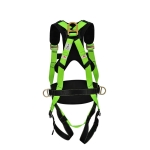

A body harness with leg straps is essential for workers who operate at heights, such as on scaffolding, steel structures, wind turbines, or telecom towers. This type of harness distributes weight and force across the shoulders, chest, and thighs, helping keep the body upright and reducing upward movement during suspension. Even short periods of hanging feel more secure and comfortable when the harness supports the body properly.
In practice, workers notice how easily the harness adjusts while wearing gloves, whether the leg straps remain comfortable during long shifts, if the back D-ring stays centered during movement, and how it performs when climbing ladders or changing levels. A harness that fits well and allows freedom of movement can make a significant difference in safety and usability, while poor balance or tight straps can reduce effectiveness even in certified products.
The typical structure includes shoulder webbing, a chest strap, thigh loops, a rear D-ring, side adjustment buckles, and reinforced stitching. Materials such as strong polyester webbing, durable D-rings, corrosion-resistant buckles, and industrial-grade stitching ensure long-term reliability. Safety standards like EN 361, ANSI Z359, and OSHA guidelines provide benchmarks for performance and make certified harnesses easier to use correctly on-site. Choosing a body harness with leg straps that combines comfort, adjustability, and secure support encourages proper use, which directly improves overall safety.
Overall, a body harness with leg straps balances stability, adaptability, and comfort. It supports continuous movement, helps distribute forces effectively during a fall, and is suitable for a wide range of industrial and construction tasks where workers operate at height.