

Bamboos Market to Reach USD 123.92 Billion by 2034, Driven by Sustainable Materials and Industrial Demand
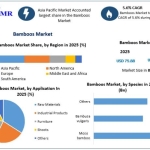
The Bamboos Market is expanding as industries seek renewable alternatives to conventional wood, plastics, and resource-intensive materials. According to Maximize Market Research, the Bamboos Market was valued at USD 75.88 billion in 2025 and is projected to grow at a CAGR of 5.6% from 2026 to 2034, reaching nearly USD 123.92 billion by 2034. Growth is supported by infrastructure investment, sustainable construction, consumer awareness, and bamboo’s versatility across industrial, furniture, flooring, packaging, and textile applications. Bamboo’s renewability, lightweight structure, strength, and environmental benefits strengthen its appeal. Opportunities are emerging in engineered bamboo, composites, packaging, bamboo fiber, and sustainable construction.
United States Market Trends and Investment
The United States market is seeing stronger interest in bamboo for construction, interiors, household products, and circular-economy applications. In February 2025, Smith & Fong introduced Plyboo Pro, a bamboo plywood line for kitchen cabinetry, expanding bamboo’s role in construction and interiors. RENEW by TRINITY showcased home products made from reclaimed bamboo chopsticks at The Inspired Home Show 2025, including furniture, storage, and pet products. Washington State University researchers reported that a startup partner was preparing production of corrugated bamboo panels for durable, affordable roofing and temperature reduction. These developments point to increasing investment in product development, processing, circular material use, and sustainable building solutions.
Request a Sample PDF of the Market Report : https://www.maximizemarketresearch.com/request-sample/126098/
Market Segmentation: Leading Segment
By application, the Industrial Products segment held the largest share of the global Bamboos Market in 2025, accounting for approximately 35.0% of total sales. Bamboo is processed into plywood, flooring, pulp and paper, supporting demand from construction, manufacturing, interiors, and commercial applications. The segment’s leadership reflects bamboo’s adaptability, durability, and replacement potential.
Competitive Analysis
The competitive landscape includes bamboo specialists and producers expanding applications, processing capabilities, sustainability, and distribution. Five prominent key players are MOSO International B.V., Bamboo Australia Pty. Ltd., Bamboo Village Company Limited, EcoPlanet Bamboo, and China Bamboo Textile Company Limited.
MOSO International B.V. emphasizes engineered bamboo solutions for flooring, decking, cladding, panels, and architectural applications. In 2025, its Bamboo Thermo and redesigned Bamboo X-treme products received a favorable U.S. court ruling in a patent dispute, supporting continued commercialization of its modified manufacturing processes. MOSO maintains a strong innovation focus around outdoor-treated and high-performance bamboo products.
Bamboo Australia Pty. Ltd. operates in an Australian ecosystem focused on cultivation, construction, bio-products, and sustainable development. Industry initiatives in 2025 emphasized structural engineered bamboo and sustainable finance, creating opportunities for commercial plantation and construction applications.
Bamboo Village Company Limited represents the market’s focus on bamboo processing and value-added products. Continued development of bamboo-based products can support greater resource utilization and expand applications.
EcoPlanet Bamboo focuses on commercial-scale sustainable bamboo plantations and industrial fiber supply. Its model targets degraded land restoration while creating feedstock for pulp, textiles, composites, activated carbon, and renewable materials.
China Bamboo Textile Company Limited participates in the expanding bamboo-fiber and textile ecosystem. Advances in bamboo processing and the shift toward bio-based fibers can create opportunities for sustainable apparel, home textiles, and technical textile applications.
Regional Analysis
China remains critical to the global bamboo industry because of its resources, processing base, and export capabilities. In 2025, China continued promoting bamboo as a substitute for plastics, with improved processing technologies enabling products such as food trays, plates, charcoal-based products, and other consumer goods. National policy has also supported modern bamboo industrial systems. China’s production ecosystem and emphasis on replacing plastics provide a foundation for worldwide demand.
The United States is another important market, supported by sustainable construction trends, product innovation, and consumer interest in renewable materials. The UK, Germany, France, and Japan offer opportunities through demand for sustainable interiors, engineered materials, furniture, flooring, and eco-conscious products. Across these countries, growth is increasingly connected with material innovation, sustainability requirements, and efforts to reduce dependence on conventional resource-intensive materials.
Key Players
Key players identified in the Maximize Market Research report include MOSO International B.V., Bamboo Australia Pty. Ltd., Bamboo Village Company Limited, EcoPlanet Bamboo, China Bamboo Textile Company Limited, Southern Bamboo Inc., Dasso Industrial Group Co., Ltd., Smith & Fong Co. Inc., Anji Tianzhen Bamboo Flooring Co. Ltd., Bamboo Bio Composites Sdn Bhd, Shanghai Tenbro Bamboo Textile Co. Ltd., Kerala State Bamboo Corporation Ltd., and Jiangxi Feiyu Industry Co. Ltd.
Why This Market Matters Now
The Bamboos Market matters now because sustainability is becoming a requirement across construction, packaging, furniture, textiles, and industrial manufacturing. Bamboo provides a rapidly renewable feedstock for products traditionally made from timber, plastics, and other materials. Technology is expanding its performance range through engineered boards, fibers, composites, advanced treatments, and automated processing. Government initiatives and private-sector innovation are encouraging cultivation, processing, research, and commercialization. With the market projected to reach USD 123.92 billion by 2034, companies developing efficient processing, scalable supply chains, higher-value applications, and credible sustainability solutions can participate in the next phase of bamboo development.
Explore More Related Reports:
Global Pharmaceutical Grade Sodium Chloride Market https://www.maximizemarketresearch.com/market-report/global-pharmaceutical-grade-sodium-chloride-market/70360/
Global Liquid Roofing Market https://www.maximizemarketresearch.com/market-report/global-liquid-roofing-market/97330/
About Maximize Market Research
Maximize Market Research Pvt. Ltd. (MMR) is a global market research and consulting company providing reliable, data-focused, and practical business insights. The firm serves healthcare, pharmaceuticals, technology, automotive, electronics, chemicals, personal care, and consumer goods. Through market forecasts, competitive analysis, strategic consulting, and industry impact assessments, MMR helps organizations understand changing market conditions, identify growth opportunities, and make informed decisions for long-term success.
Contact Us
2nd Floor, Navale IT Park Phase 3
Pune Banglore Highway, Narhe
Pune, Maharashtra 411041, India
+91 9607365656
sales@maximizemarketresearch.com