



Large language models (LLMs) have transformed how businesses generate content, answer questions, summarize information, and interact with customers. However, their ability to produce fluent and convincing responses comes with a significant challenge: hallucinations. An LLM may generate information that sounds accurate but is factually incorrect, unsupported, or completely fabricated.
For organizations deploying generative AI in customer service, healthcare, finance, legal technology, research, and enterprise applications, hallucinations can undermine user trust and create operational risks. This makes systematic LLM QA testing services essential for identifying, measuring, and reducing unreliable model outputs before and after deployment.
What Are LLM Hallucinations?
An LLM hallucination occurs when a model produces information that is inaccurate, misleading, or unsupported by the available evidence. Hallucinations can take several forms, including fabricated facts, incorrect citations, invented sources, false summaries, and misleading reasoning.
For example, an AI assistant might confidently provide a nonexistent research paper, attribute a statement to the wrong person, or answer a question with outdated information. Because the response may be grammatically polished and contextually relevant, traditional software testing methods may not be sufficient to identify the problem.
LLM QA testing therefore needs to evaluate not only whether a response is generated, but whether that response is accurate, grounded, relevant, consistent, and appropriate for its intended use case.
Why Hallucination Testing Matters
Hallucinations can have different consequences depending on the application. In a customer support chatbot, an incorrect response may frustrate users or provide misleading product information. In financial or healthcare applications, inaccurate outputs can create substantially greater risks.
Effective hallucination testing helps organizations:
-
Detect factual inaccuracies before users encounter them.
-
Identify prompts and scenarios that trigger unreliable outputs.
-
Measure model performance across different domains.
-
Validate whether responses are grounded in trusted information.
-
Compare model versions and monitor improvements.
-
Reduce risks associated with deploying generative AI at scale.
This is why hallucination detection should be treated as an ongoing quality assurance process rather than a one-time model evaluation.
How LLM QA Testing Detects Hallucinations
A robust QA framework combines automated evaluation, structured datasets, and human review. Each method addresses different aspects of model reliability.
1. Building Hallucination-Focused Evaluation Datasets
The quality of an evaluation depends heavily on the quality of its test data. Annotation teams can create datasets containing factual questions, domain-specific queries, ambiguous prompts, adversarial questions, and scenarios where the model should explicitly acknowledge insufficient information.
Human annotators can label expected answers, factual claims, supporting evidence, and acceptable response variations. These datasets create a consistent benchmark against which model outputs can be evaluated.
2. Fact and Claim Verification
Instead of evaluating an entire response as simply “correct” or “incorrect,” QA teams can break responses into individual claims.
For example, a generated answer containing five factual statements can be assessed claim by claim. Reviewers can determine whether each statement is supported by an authoritative source, partially correct, unverifiable, or false.
This granular approach makes it easier to identify the exact areas where a model is generating unreliable information.
3. Groundedness and Source Verification
Retrieval-augmented generation (RAG) systems are designed to ground model responses in external knowledge sources. However, retrieving information does not automatically guarantee that the generated response accurately reflects it.
LLM QA testing can compare generated answers with retrieved documents to determine whether claims are actually supported by the available context. Evaluators can also assess citation accuracy, source relevance, and whether the model introduces unsupported information.
4. Human Evaluation
Automated metrics are useful for scaling evaluation, but human reviewers remain critical for nuanced hallucination detection. Expert annotators can assess factuality, context adherence, relevance, reasoning quality, and response consistency.
Human evaluation is especially valuable when there are multiple acceptable answers or when factual accuracy depends on domain-specific context.
This human-in-the-loop approach supports stronger generative AI quality control by combining computational efficiency with human judgment.
Testing the Prompts That Trigger Hallucinations
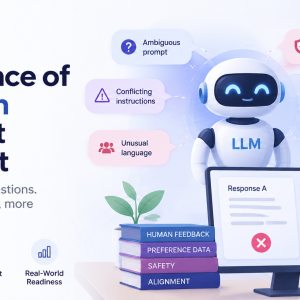
Hallucinations are not always evenly distributed across queries. Certain prompt patterns may increase the likelihood of unreliable responses.
QA teams can deliberately test:
-
Ambiguous or incomplete questions.
-
Questions containing false assumptions.
-
Requests for obscure facts.
-
Multi-step reasoning tasks.
-
Questions about recent or changing information.
-
Prompts requiring specific citations.
-
Contradictory or misleading instructions.
-
Long-context conversations.
-
Domain-specific terminology.
These tests help organizations identify failure patterns rather than simply measuring an overall hallucination rate.
Measuring Hallucination Risk
Organizations need measurable indicators to determine whether a model is improving. Depending on the application, QA teams can track metrics such as factual accuracy, unsupported-claim rate, groundedness, citation correctness, response consistency, and refusal accuracy.
A particularly important measure is whether the model knows when it does not know something. A reliable AI system should not be forced to answer every question. In certain scenarios, acknowledging uncertainty or requesting additional information is a better outcome than generating a confident but incorrect response.
Preventing Hallucinations Through Continuous QA
Detection is only one part of the process. The findings from LLM QA testing can also support model improvement.
Organizations can use evaluation results to refine prompts, improve retrieval pipelines, update knowledge sources, modify system instructions, enhance training datasets, and establish clearer response policies.
High-risk failure cases can be added to regression test suites so that future model updates are tested against previously identified weaknesses. This creates a continuous QA cycle:
Test → Detect → Analyze → Improve → Retest → Monitor
Such continuous evaluation is particularly important because changes to prompts, models, retrieval systems, or datasets can introduce new failure modes.
The Role of Annotation Teams in LLM QA
High-quality human annotation provides the foundation for reliable hallucination evaluation. Annotation specialists can categorize model responses, verify claims, compare outputs against reference information, identify unsupported statements, and flag edge cases.
For organizations managing large-scale AI deployments, outsourcing this work to experienced LLM QA testing services providers can help expand evaluation capacity while maintaining consistent quality standards.
A structured annotation workflow can also produce valuable evaluation datasets for regression testing, benchmarking, and model refinement.
Building More Trustworthy Generative AI
LLM hallucinations cannot be addressed by relying on a single metric or testing method. Effective quality assurance requires a combination of representative evaluation datasets, automated checks, human expertise, source verification, adversarial testing, and continuous monitoring.
As generative AI becomes embedded in increasingly critical business processes, hallucination detection must become an integral part of the AI development lifecycle. Organizations that invest in systematic testing can identify weaknesses earlier, improve model reliability, and create safer user experiences.
For businesses seeking scalable generative AI quality control, combining expert annotation with structured LLM evaluation provides a practical path toward more dependable AI systems. By continuously testing how models respond to factual, ambiguous, domain-specific, and challenging prompts, organizations can move beyond impressive language generation toward AI that users can genuinely trust.