




In the production of technical textiles, nonwovens, and protective membranes, keeping fabric quality consistent from beginning to end is a major challenge. Traditional quality inspection often depends on taking samples from finished rolls and sending them to a laboratory for testing.
This method can provide accurate results, but it also has an obvious limitation: the problem may only be discovered after a large amount of material has already been produced.
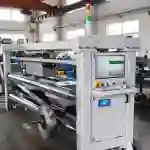
For high-speed production lines, manufacturers are therefore paying more attention to real-time inspection. An online breathability/thickness detector can monitor important fabric properties directly during production, helping manufacturers identify changes earlier and reduce unnecessary material waste.
Why Online Detection Is Different
Thickness and breathability are two important properties for many technical textile products.
Thickness affects material weight, structure, handling, and final product performance. Air permeability is also important for products such as filtration materials, protective fabrics, membranes, and nonwovens.
With traditional offline testing, operators normally collect samples at certain intervals. If the fabric changes between two samples, the production team may not know about the problem until the next test.
An online system takes a different approach. Instead of checking only selected samples, it continuously monitors the moving fabric during production.
This makes online fabric thickness detection and online fabric breathability detection useful for manufacturers that need closer control over production consistency.
Measuring Thickness and Breathability During Production
A combined inspection system can monitor both physical thickness and air permeability without stopping the production line.
For thickness measurement, the system uses sensors positioned around the moving fabric to identify changes in the material's thickness. This makes it possible to find uneven areas that may otherwise remain unnoticed until offline inspection.
The breathability measurement works differently. The system evaluates how air passes through the textile and uses the measured air pressure or airflow changes to determine the material's permeability.
By combining these two measurements, manufacturers can obtain a more complete picture of the fabric rather than relying on a single quality indicator.
This is particularly useful for continuous production where even small changes can affect a large quantity of finished material.
Dealing With High-Speed Production Conditions
Installing measurement equipment on a production line is not as simple as placing a laboratory instrument beside a machine.
The fabric may move at high speed and experience vibration, flutter, static electricity, temperature changes, and airborne fibers. All of these factors can influence measurement stability.
A high precision online fabric thickness gauge therefore needs to work reliably under actual factory conditions.
Several measures can help improve measurement stability:
- Web stabilization: Guide or support components can help keep the moving fabric in a more stable position during measurement.
- Environmental compensation: The system can compensate for changes in temperature and other environmental factors that may influence sensor performance.
- Signal processing: Digital filtering can reduce interference caused by mechanical vibration and other background noise.
These functions help the measurement system provide more consistent data while the production line continues to operate.
Using Breathability Data to Improve Production
Air permeability can change when the distribution of fibers or the structure of a nonwoven material changes.
For example, a change during spinning, bonding, or other production processes may create areas that are too dense or too open. If this problem is discovered only after the material has been produced, part of the roll may already need to be downgraded or discarded.
An online fabric breathability measurement system allows manufacturers to see these changes much earlier.
The collected data can be compared with preset limits. When the measured value begins to move outside the expected range, operators can investigate the production process and make adjustments.
Depending on the production line, the information may also be connected with the PLC system to support adjustments to equipment such as pump speed, production speed, or calender pressure.
Clear Data Makes Quality Control Easier
Another important function of an online inspection system is data management.
Modern systems can continuously record measurement results throughout the production process. Instead of receiving only a test result from a small fabric sample, operators can review changes across the entire roll.
The system can display thickness and breathability information through an HMI or industrial touchscreen. Production teams can set different tolerance ranges according to the fabric being produced.
When an abnormal area is detected, the system can record its position and provide an alarm. This information can later help operators locate the defective section during rewinding, slitting, or other finishing processes.
For manufacturers, this creates a clearer connection between production data and the finished roll.
Reducing Waste and Improving Product Consistency
The value of online inspection is not limited to finding obvious defects.
When manufacturers have a better understanding of fabric thickness and breathability throughout production, they can avoid producing material with unnecessary safety margins.
For example, if a manufacturer needs to maintain a certain minimum thickness or breathability level, continuous measurement can provide better information about how close the material is to the required range.
This can help manufacturers reduce unnecessary material use while maintaining product requirements.
For customers, detailed production records can also provide useful quality information. Roll-level data can make it easier to trace production conditions and respond to quality questions.
The Role of Ningbo Textile
As textile production becomes faster and more automated, online measurement is becoming an increasingly useful part of quality control.
Ningbo Textile provides online inspection solutions designed to monitor fabric thickness and breathability during continuous production. By combining real-time measurement, data collection, alarms, and production-line integration, the system helps manufacturers identify quality changes before they become larger production problems.
For technical textile and nonwoven manufacturers, moving from occasional offline testing to continuous monitoring can provide a clearer understanding of what is happening throughout the entire roll.
Conclusion
Traditional laboratory testing still has an important role in textile quality control, but it cannot always provide immediate information during high-speed production.
An online breathability/thickness detector adds another layer of protection by monitoring fabric properties while the material is being produced. It can help manufacturers identify thickness changes, monitor air permeability, locate abnormal areas, reduce waste, and maintain more consistent product quality.
For manufacturers working with technical textiles, nonwovens, and protective membranes, combining online measurement with existing quality inspection methods can make production control more efficient and responsive.
https://www.nbfyti.com/redefining-breathability-metrics-in-technical-textile-extrusion.html