
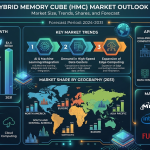

The increasing demand for high-speed computing infrastructure across the United States and other North American economies is driving greater attention toward advanced memory architectures. Data centers, high-performance computing (HPC), artificial intelligence (AI), networking, scientific computing, and advanced semiconductor systems require faster movement of data between processors and memory. Hybrid Memory Cube (HMC) technology was developed around a three-dimensional architecture that combines stacked DRAM with a logic layer using through-silicon vias (TSVs), creating a high-bandwidth approach to memory-intensive computing. Micron introduced HMC as a technology designed to address performance requirements in demanding computing and networking applications.
The Hybrid Memory Cube (HMC) Market Size in North America is closely associated with the region's strong semiconductor ecosystem, advanced data-center infrastructure, and concentration of technology companies developing AI, networking, and HPC platforms. The United States remains an important technology hub for advanced processors, memory solutions, cloud infrastructure, and computing research. The regional opportunity is influenced by the continued need for high memory bandwidth and efficient data movement, although the HMC technology landscape has evolved considerably as newer high-bandwidth memory architectures have emerged.
Download Sample PDF: https://www.theinsightpartners.com/sample/TIPEL00002047
Strong US Demand for High-Performance Computing
The United States has a large installed base of data centers, enterprise computing systems, cloud platforms, research facilities, and specialized HPC infrastructure. These environments process increasingly complex workloads requiring rapid access to large datasets. Memory bandwidth can become an important system-level consideration as processors and accelerators become more powerful.
HMC was specifically developed to address memory bandwidth and latency requirements through stacked memory and a high-speed logic interface. Earlier HMC deployments demonstrated applications across HPC, data science, networking, and accelerator-based systems. Micron has documented HMC adoption in HPC platforms and high-performance networking applications, including systems developed by Fujitsu and networking platforms from Juniper and other customers.
AI and Data-Center Infrastructure Shape Regional Demand
Artificial intelligence is transforming the US data-center landscape and increasing requirements for memory bandwidth, capacity, and energy efficiency. AI training and inference involve continuous movement of data between processors, accelerators, memory, and storage. As AI models become more computationally demanding, memory architecture becomes an important component of overall infrastructure performance.
Although HMC itself has been superseded in many high-performance applications by newer memory technologies, the architectural principles established by HMC remain relevant to the evolution of stacked and high-bandwidth memory. Micron currently highlights HBM as a core technology for AI and HPC, with its latest HBM solutions designed to provide high bandwidth for demanding workloads.
This transition is particularly relevant in North America, where hyperscale cloud providers, semiconductor companies, AI developers, universities, research laboratories, and technology enterprises continue investing in accelerated computing infrastructure.
Advanced Semiconductor Development Supports Innovation
The United States has historically played an important role in the development of advanced memory and semiconductor technologies. HMC itself was developed through collaboration among semiconductor and technology companies, while IBM's advanced TSV manufacturing technology supported early commercial production of HMC devices. IBM and Micron announced in 2011 that HMC devices would be manufactured using IBM's advanced semiconductor fabrication technology in East Fishkill, New York.
This history demonstrates the importance of North American semiconductor engineering capabilities in developing advanced memory architectures. Research and development involving chip stacking, packaging, interconnects, thermal management, and processor-memory integration continues to influence the evolution of high-bandwidth computing technologies.
Growth of Cloud Computing and Networking
North America's extensive cloud-computing infrastructure represents another important driver for advanced memory technologies. Cloud providers operate large-scale server and networking environments where system performance, power consumption, and data throughput directly influence infrastructure efficiency.
HMC was applied in high-performance networking, including applications involving advanced routers and data-center switches. Micron has noted HMC's use in 400G-and-beyond networking applications, demonstrating the technology's relevance to high-throughput communications infrastructure.
As US data centers increasingly support AI workloads, cloud services, edge computing, and real-time analytics, demand for memory architectures capable of supporting high-speed data movement continues to influence semiconductor design decisions.
Energy Efficiency and System-Level Performance
Power consumption has become increasingly important for North American data-center operators because high-density computing infrastructure can create substantial energy and cooling requirements. Memory technologies therefore need to balance bandwidth, capacity, latency, thermal performance, and energy efficiency.
HMC's vertically stacked design was developed to improve data transfer efficiency while providing high bandwidth within a compact package. Earlier HMC implementations demonstrated the potential for high bandwidth and lower energy consumption in memory-intensive applications.
However, the competitive environment has evolved. Micron states that it moved away from HMC as newer high-performance memory technologies entered the market and the volume projects supporting HMC reached maturity. The company subsequently expanded its focus toward HBM and other high-performance memory solutions.
Competitive Landscape
Companies associated with the broader HMC ecosystem have included Micron Technology, IBM, Intel, ARM, Fujitsu, NVIDIA, Xilinx, Samsung Electronics, SK hynix, and other semiconductor and computing technology organizations. The competitive landscape has increasingly shifted toward alternative high-bandwidth memory architectures and advanced packaging technologies.
For North American applications, the evolution from HMC toward HBM and other advanced memory solutions illustrates how rapidly computing requirements are influencing semiconductor innovation. Current AI and HPC infrastructure increasingly incorporates high-bandwidth memory alongside advanced processors and accelerators.
Future Outlook for North America
The future development of the North American advanced-memory ecosystem will be influenced by AI infrastructure expansion, HPC investments, cloud computing, advanced networking, semiconductor manufacturing, and three-dimensional packaging technologies. While HMC represents an important stage in the development of high-bandwidth memory architectures, newer technologies are increasingly addressing similar requirements.
Micron's current data-center portfolio emphasizes HBM, DDR5, RDIMM, MRDIMM, and SOCAMM for AI and HPC applications, reflecting the broader transition toward memory solutions optimized for modern computing architectures.
For the United States and wider North American region, continued investment in AI data centers, scientific computing, advanced processors, and semiconductor manufacturing is expected to sustain demand for increasingly sophisticated memory technologies. HMC's architectural innovations, particularly stacked memory, TSV integration, and high-speed interfaces, remain part of the technological progression that has shaped today's high-bandwidth memory ecosystem.
About The Insight Partners
The Insight Partners is a globally recognized market research and consulting firm providing reliable and actionable insights across technology, semiconductors, electronics, healthcare, energy, industrial, and other major industries. The company provides comprehensive research covering industry trends, competitive landscapes, growth drivers, opportunities, and strategic developments.
Contact Us
The Insight Partners
Email: sales@theinsightpartners.com
Phone: +1-646-491-9876
Website: https://www.theinsightpartners.com
Related Reports -
Submarine Fiber Cable Market Demand, Share & Growth by 2034
Aircraft Wiring Harness Market Dynamics and Trends by 2030
SCADA Oil and Gas Market Size, Trends & Growth by 2034