

The rapid transformation of manufacturing and industrial operations across North America is accelerating demand for intelligent automation capable of responding to changing production conditions. US manufacturers are increasingly integrating artificial intelligence, advanced sensors, computer vision, machine learning, and robotics to improve productivity, quality, operational flexibility, and workforce efficiency. The expansion of smart factories, reshoring initiatives, and digitally connected production environments is creating a strong foundation for next-generation robotic systems across the region.
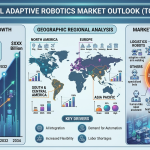
The Adaptive Robotics Market Size is expected to reach US$86.56 billion by 2034, rising from US$11.22 billion in 2025, at a CAGR of 25.49% from 2026 to 2034. The addressable market is estimated at US$371.06 billion during 2026–2034, reflecting substantial opportunities across manufacturing, logistics, automotive, electronics, healthcare, food processing, aerospace, and other industries. North America, particularly the US, represents an important growth environment because of its established automation infrastructure and increasing emphasis on intelligent and flexible production technologies.
Download Sample PDF: https://www.theinsightpartners.com/sample/TIPRE00007943
US Manufacturing Automation Drives Adaptive Robotics Adoption
The US is a major center for robotics deployment in North America. According to the International Federation of Robotics, industrial robot installations in the US increased 11% year over year to approximately 38,000 units in 2025. The automotive sector remained the largest adopter, while food and other non-manufacturing industries also recorded significant growth. The US manufacturing industry had a robot density of 307 robots per 10,000 manufacturing employees in 2025.
This expansion provides an important foundation for adaptive robotics. Unlike conventional systems designed around highly repetitive production environments, adaptive robots can incorporate information from sensors, cameras, software, and AI algorithms to respond to variations in products, materials, workflows, and operating conditions. This capability is particularly valuable for US manufacturers seeking flexible automation that can accommodate shorter production runs and rapidly changing customer requirements.
Labor Shortages Strengthen Demand for Flexible Automation
Labor availability is another important driver across the US. NIST identifies labor shortages and an aging workforce as factors increasing the importance of robotics and automation for US manufacturing. The agency also highlights the need for robots that are adaptable, easily tasked, capable of working safely with people, and rapidly integrated into manufacturing operations.
Adaptive robotics can help address these requirements by performing repetitive, physically demanding, or precision-oriented activities while allowing employees to focus on higher-value responsibilities. For manufacturers facing workforce constraints, flexible robotic systems can support production continuity without requiring every process to remain dependent on manual labor.
The benefits extend beyond large industrial facilities. Advances in sensors, software, and vision systems are making robotics increasingly accessible to small and midsized manufacturers, expanding the potential customer base for adaptive automation technologies across the US.
AI and Machine Learning Transform US Robotic Systems
Artificial intelligence is becoming a central technology behind adaptive robotics. US manufacturers are increasingly applying AI to production planning, predictive maintenance, quality control, process optimization, and robotics. NIST reports that more than 80% of manufacturers surveyed expect to increase their use of AI over the following two years, while AI-powered robotics can enable adaptive assembly, collaborative operations, and autonomous material handling.
The combination of AI and robotics enables machines to interpret information rather than simply execute predetermined commands. Computer vision can help robots identify parts and detect defects, while machine learning can support pattern recognition and process optimization. These capabilities are particularly relevant to North American manufacturers seeking greater flexibility across production environments.
Reshoring and Smart Manufacturing Create New Opportunities
Reshoring and supply-chain resilience are also supporting investment in automation across North America. US manufacturers are seeking more responsive domestic production capabilities, increasing the importance of technologies that can improve efficiency while handling product and process variations.
NIST notes that US manufacturers are increasingly focused on smarter supply chains, advanced technologies, AI, automation, and flexible production. Flexible automation allows manufacturers to adjust production lines more efficiently and support smaller batch sizes without sacrificing operational efficiency.
Adaptive robotics therefore fits closely with the broader development of smart factories. Integration with industrial IoT platforms, digital twins, cloud systems, edge computing, and real-time analytics can allow robotic systems to become part of interconnected production ecosystems.
Expansion Across North American Industries
Automotive manufacturing remains a major application area in the US, but demand is increasingly extending into food and beverage, electronics, metals and machinery, logistics, warehousing, pharmaceuticals, aerospace, and consumer products. In 2025, US food-industry robot installations experienced particularly strong growth, demonstrating the expansion of automation beyond traditional automotive applications.
Canada and Mexico also contribute to the North American opportunity through automotive, electronics, logistics, and industrial manufacturing activities. The interconnected regional supply chain creates opportunities for robotic technologies that can support standardized yet flexible production processes across multiple facilities.
Top Players in the Adaptive Robotics Market
Key companies operating in the adaptive robotics ecosystem include ABB Ltd., FANUC Corporation, KUKA AG, Yaskawa Electric Corporation, Universal Robots A/S, Mitsubishi Electric Corporation, Omron Corporation, Denso Corporation, Kawasaki Heavy Industries Ltd., Epson Robots, Stäubli International AG, Comau S.p.A., Bosch Rexroth AG, Festo SE & Co. KG, Schunk GmbH & Co. KG, Techman Robot Inc., and ATI Industrial Automation Inc. These companies are developing and integrating industrial robots, collaborative robots, machine vision, motion-control technologies, sensors, automation software, and AI-enabled robotic solutions.
Future Outlook
The North American outlook for adaptive robotics is closely connected with the evolution of intelligent manufacturing. Continued investments in AI, advanced sensing, computer vision, collaborative robotics, and autonomous systems are expected to improve robotic flexibility and expand the range of tasks that machines can perform.
The US is also developing greater infrastructure and technical capabilities around AI-enabled manufacturing. In 2026, NIST published a roadmap highlighting AI and machine learning applications across smart manufacturing, including advanced sensing and perception, autonomous systems, digital twins, robotics, logistics optimization, and sustainable manufacturing.
As manufacturers pursue higher productivity, workforce efficiency, supply-chain resilience, and more flexible production, adaptive robotics is positioned to become increasingly integrated into North American industrial operations. With global revenues projected to reach US$86.56 billion by 2034, North America and the US are expected to remain important environments for the deployment of intelligent, flexible, and AI-enabled robotic technologies.
About The Insight Partners
The Insight Partners is a globally recognized market research and consulting firm providing reliable and actionable insights across a wide range of industries. The company offers comprehensive market research reports, strategic analysis, and consulting services designed to help organizations understand industry trends, emerging technologies, growth opportunities, and competitive developments.
Contact Us
The Insight Partners
Email: sales@theinsightpartners.com
Phone: +1-646-491-9876
Website: https://www.theinsightpartners.com
Related Reports -
Submarine Fiber Cable Market Demand, Share & Growth by 2034
Aircraft Wiring Harness Market Dynamics and Trends by 2030
SCADA Oil and Gas Market Size, Trends & Growth by 2034