





Market Overview
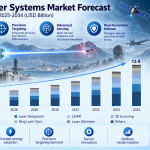
According to a research report by IMARC Group, the global military laser systems market size reached USD 7.0 Billion in 2025. Looking forward, IMARC Group estimates the market to reach USD 12.9 Billion by 2034, exhibiting a growth rate (CAGR) of 6.82% during 2026-2034. North America currently dominates the regional landscape, accounting for a 37.8% market share in 2025, supported by high defense spending, continuous research funding, established defense contractors, a strong industrial base, frequent military upgrades, and procurement programs.
-
Market Size & Growth: The global military laser systems market reached USD 7.0 Billion in 2025 and is projected to reach USD 12.9 Billion by 2034, registering a CAGR of 6.82% during 2026–2034, according to IMARC Group.
-
Regional Leadership: North America represents the largest regional market, accounting for 37.8% of the market share in 2025, supported by robust defense budgets, established defense contractors, continuous research funding, and military modernization programs.
-
By Product Type: The market is segmented into laser designators, LIDAR, 3D scanning, laser weapons, laser range finders, ring laser gyros, laser altimeters, and others, with laser weapons representing the largest segment.
-
By Technology: The market covers fiber lasers, solid-state lasers, chemical lasers, CO2 lasers, semiconductor lasers, and others, with solid-state lasers holding the leading position.
-
By Application: The market spans target designation and ranging, guiding munitions, directed energy weapons, defensive countermeasures, and others, with target designation and ranging accounting for the largest share.
-
By End Use: The market is divided into defense and homeland security, with defense representing the dominant segment and accounting for 73.7% of the market.
-
Key Market Drivers: Rising defense budgets, increasing focus on precision targeting, growing homeland security requirements, technological advancements in laser optics and energy sources, and increasing collaborations between defense organizations and technology companies.
-
Key Market Trends: Growing deployment of high-energy laser systems, increasing counter-drone applications, advances in beam management and AI integration, development of compact laser configurations, and rising adoption across land, air, and naval platforms.
-
Key Market Opportunities: Continued military modernization, development of next-generation directed-energy systems, increasing demand for counter-UAS solutions, expansion of indigenous defense capabilities, and growing international defense collaborations.
Request for a Sample Report for Detailed Evaluation: https://www.imarcgroup.com/military-laser-systems-market/requestsample
What Is Driving Military Laser Systems Market Growth in 2026?
Rising Defense Budgets
Increasing investments aimed at strengthening defense capabilities are emerging as a key factor driving the military laser systems market. Nations facing regional conflicts and evolving security threats are allocating greater resources to advanced defense technologies, including high-energy energy weapons and directed energy weapons. Rising defense budgets are supporting the procurement and deployment of advanced military laser systems while also enabling long-term research and development programs focused on next-generation defense requirements.
Modern military operations increasingly require technologies that can engage threats with high accuracy while minimizing unintended effects. Military laser systems address these requirements by providing precision targeting, rapid response, and scalable engagement capabilities against threats such as drones, missiles, and other airborne targets. The growing emphasis on accurate, efficient, and cost-effective defense solutions is consequently contributing to increased demand for laser military weapons and other directed-energy defense technologies.
Growing Focus on Homeland Security
The increasing application of advanced technologies to address homeland security requirements and protect critical infrastructure is also supporting market growth. Defense forces and homeland security organizations are increasingly utilizing laser technologies for threat detection, surveillance, border monitoring, and counter-drone operations.
Military laser systems offer high accuracy and rapid response capabilities, making them suitable for a range of security applications. Their adaptability across different operational environments is encouraging their integration into broader national security strategies.
Advancements in Laser Technology
Continuous advancements in laser optics, energy sources, beam management, cooling systems, and compact configurations are enhancing the capabilities of military laser systems. Improvements in beam quality and system efficiency are increasing operational reliability while modular components are facilitating integration across aircraft, naval vessels, and ground vehicles.
The development of smaller and more powerful systems is further broadening the potential applications of directed-energy technologies. These technological improvements are encouraging defense organizations to explore laser-based solutions for increasingly diverse military requirements.
Increasing Collaborations
Growing collaborations between defense contractors, government agencies, and specialized research organizations are contributing to market expansion. These partnerships combine technological expertise, financial resources, research capabilities, and manufacturing capacity to address the complex requirements of contemporary warfare.
Joint development programs and co-development initiatives also help distribute development costs and risks while accelerating the testing and implementation of new systems. Such collaborations are supporting the development of laser technologies tailored to changing operational requirements.
Military Laser Systems Market Segmentation Analysis
By Product Type
-
Laser Designator
-
LIDAR
-
3D Scanning
-
Laser Weapon
-
Laser Range Finder
-
Ring Laser Gyro
-
Laser Altimeter
-
Others
Laser weapons represent the largest product type segment, accounting for 38.7% of the market share. Their leading position is attributed to their ability to address increasing requirements for accuracy, rapid response, and cost-efficient engagement in contemporary military operations.
Laser weapons provide precise targeting with limited unintended effects, making them suitable for operations requiring targeted engagement against threats. Their ability to engage multiple targets without the need for conventional ammunition replenishment can reduce logistical requirements and operational costs.
Defense forces are increasingly focusing on laser weapons for countering drones, missiles, and small boats. Advances in compact, high-energy laser technologies are also enabling integration across ground vehicles, naval vessels, and aircraft. Continued research, increased defense funding, and field trials are further supporting their adoption.
By Technology
-
Fiber Laser
-
Solid-State Laser
-
Chemical Laser
-
CO2 Laser
-
Semiconductor Laser
-
Others
Solid-state lasers dominate the market owing to their energy efficiency, compact form factor, and reliable operation in demanding combat environments. These systems produce concentrated beams through solid gain materials and can be integrated into various military platforms.
Their scalable design enables defense contractors to develop increasingly powerful systems for applications including missile defense and counter-drone operations. Solid-state laser technology has also benefited from extensive commercial and defense research, resulting in improvements in beam quality, durability, and cost efficiency.
Continuous technological advancements are helping reduce system size and power requirements while increasing output. This combination of operational adaptability, technological development, and established applications is supporting the leading position of solid-state lasers in the military laser systems market.
By Application
-
Target Designation and Ranging
-
Guiding Munitions
-
Directed Energy Weapon
-
Defensive Countermeasures
-
Others
Target designation and ranging represent the largest application segment. These systems are essential for improving targeting accuracy and operational effectiveness by enabling military forces to identify, mark, and monitor targets across different distances.
Their ability to support guided munitions while reducing the likelihood of unintended effects makes them important for modern combat operations. Continued improvements in range, targeting speed, and compatibility with other sensor technologies are further strengthening their relevance.
The increasing deployment of drones and advanced ground vehicles is expanding the application of laser-based targeting and ranging systems. Defense initiatives also continue to allocate resources toward improving these capabilities for joint operations and surveillance, supporting sustained demand.
By End Use
-
Defense
-
Homeland Security
Defense represents the largest end-use segment, accounting for 73.7% of the market share. The segment's dominance is supported by the growing focus of armed forces on advanced directed-energy technologies for target neutralization, surveillance, threat deterrence, and precision engagement.
Military organizations are allocating resources toward the integration of laser systems into applications such as missile interception and counter-drone operations. Long-term defense contracts covering research, testing, implementation, training, maintenance, and system integration are also supporting sustained demand.
Continued collaboration between military organizations and private-sector defense companies is facilitating the development of operational laser systems, further reinforcing defense as the leading end-use segment.
By Region
-
North America
-
United States
-
Canada
-
-
Asia Pacific
-
China
-
Japan
-
India
-
South Korea
-
Australia
-
Indonesia
-
Others
-
-
Europe
-
Germany
-
France
-
United Kingdom
-
Italy
-
Spain
-
Russia
-
Others
-
-
Latin America
-
Brazil
-
Mexico
-
Others
-
-
Middle East and Africa
North America holds the largest share of the global military laser systems market, accounting for 37.8% in 2025. The region's leading position is supported by robust defense budgets, an established defense industrial base, continuous government support for advanced weapon initiatives, and consistent investments in directed-energy research.
The United States plays a central role in the regional market owing to its substantial defense expenditure and extensive investments in research, testing, and implementation of advanced laser systems. Established defense contractors and research organizations collaborate closely with military divisions to develop laser technologies for precise targeting, missile defense, and counter-drone applications.
Europe is witnessing growth supported by heightened regional security concerns, increasing defense expenditure, counter-UAS requirements, and collaborative defense initiatives. Asia Pacific is benefiting from rising defense expenditure, territorial tensions, indigenous defense production initiatives, and increasing investments in directed-energy technologies.
Latin America is experiencing growing demand associated with border security, counternarcotics operations, and military modernization, while the Middle East and Africa are investing in advanced border surveillance, air defense, and missile-defense technologies.
Key Regional Insight: North America's Strategic Position
North America's leading position in the global military laser systems market is anchored in high defense spending, established defense contractors, strong research capabilities, and continuous military modernization programs. Government funding supports research, testing, prototyping, and deployment of advanced laser technologies across multiple military applications.
The region's well-established industrial base also facilitates collaboration between defense companies, research institutions, and military organizations. Ongoing investments in beam management, high-energy laser systems, artificial intelligence integration, and compact configurations are supporting continued technological development.
The United States accounted for 84.90% of the North American military laser systems market, with demand supported by defense modernization initiatives and increasing investments in directed-energy technologies addressing emerging threats.
Key Regional Takeaways
United States Military Laser Systems Market Analysis
The United States represents a major market within North America, supported by substantial defense expenditure, military modernization efforts, and increasing investments in directed-energy technologies. Defense funding supports research, testing, and deployment of advanced laser systems across different branches of the military.
Increasing concerns regarding unmanned aerial vehicles and hypersonic missile threats are supporting demand for high-accuracy laser-based defensive systems. Continued progress in solid-state and fiber laser technologies is improving system efficiency and deployment flexibility across air, land, and naval platforms.
Cooperation between the U.S. Department of Defense and domestic defense contractors is also accelerating the development and testing of operational prototypes. The growing emphasis on precision targeting with limited unintended effects is further supporting interest in laser technologies for complex operational environments.
Europe Military Laser Systems Market Analysis
The European military laser systems market is witnessing growth amid heightened regional security concerns and increased defense expenditure among NATO partners. The growing threat from drones and hybrid warfare strategies is encouraging the adoption of advanced counter-UAS laser technologies.
Increasing funding for cross-border defense initiatives is supporting research and development activities and encouraging innovation in directed-energy technologies. The implementation of laser technologies on naval vessels for maritime surveillance and defense is also supporting market adoption.
Advancements in laser range-finding and precision targeting are improving capabilities for air and ground forces. Modernization of air defense systems with directed-energy components is further contributing to demand for advanced military laser systems.
Asia Pacific Military Laser Systems Market Analysis
The Asia Pacific military laser systems market is primarily influenced by rising territorial conflicts and increasing demand for advanced defense technologies. Growing defense expenditure in countries including China, India, and South Korea is supporting investment in laser weapon initiatives.
Government efforts to encourage indigenous defense production and increase technological independence are further strengthening market development. Expanding research facilities and defense innovation centers are accelerating the development of advanced directed-energy technologies.
The growing adoption of laser technologies for counter-drone applications is also supporting regional demand. Increasing participation in multinational military exercises and strategic partnerships is facilitating technology transfer, standardization, and interoperability.
Latin America Military Laser Systems Market Analysis
The military laser systems market in Latin America is expanding on account of increasing investments in border security, counternarcotics operations, and military modernization. Greater collaboration with international defense technology companies is improving access to advanced directed-energy technologies.
The implementation of modernization programs is supporting the integration of precision laser systems across land and maritime platforms. Rising defense budgets in countries such as Brazil and Colombia, combined with efforts to develop domestic technological capabilities, are further broadening regional market opportunities.
Middle East and Africa Military Laser Systems Market Analysis
Investments in advanced border surveillance and air defense technologies are significantly influencing the military laser systems market in the Middle East and Africa. The integration of laser technologies into missile-defense initiatives is supporting improvements in targeting accuracy and operational efficiency.
Collaborative defense arrangements with international technology companies are facilitating the transfer of technical expertise and supporting the deployment of advanced laser solutions. At the same time, expanding local manufacturing capabilities and defense technology parks are supporting domestic production and innovation in directed-energy technologies.
Competitive Landscape in the Military Laser Systems Industry
Leading participants in the global military laser systems market are focusing on portfolio expansion through technological innovation, research and development, strategic collaborations, and defense agreements. Companies are investing in compact, high-power laser modules designed for integration across land, air, and naval platforms.
Defense companies are also collaborating with military organizations to evaluate prototypes under operational conditions, with a focus on reliability, beam strength, range, and targeting precision. Companies are pursuing international defense agreements and long-term supply contracts to expand their market presence.
Strategic partnerships and co-development initiatives are further supporting the advancement of naval, airborne, ground-based, and counter-drone laser systems.
Key Military Laser Systems Market Players Include:
-
BAE Systems PLC
-
Coherent Inc.
-
Elbit Systems Ltd.
-
Lockheed Martin Corporation
-
MKS Instruments Inc.
-
Northrop Grumman Corporation
-
Rafael Advanced Defense Systems Limited
-
Raytheon Technologies Corporation
-
Thales Group
-
The Boeing Company
-
and others
Recent Developments:
-
June 2025: Zen Technologies secured its 54th Indian and 82nd global patent for a laser-based military training system. The patented long-pass optical filter integrates visible and infrared lasers for more realistic military simulators.
-
May 2025: NUBURU announced its planned acquisition of TEKNE, an electronic warfare and cyber defense specialist, with the objective of combining TEKNE's vehicle protection and jammer technologies with NUBURU's blue laser capabilities.
-
March 2025: HII's Mission Technologies division secured a contract to develop a High-Energy Laser weapon system for the U.S. Army. The open-architecture prototype is designed to counter Groups 1–3 drones and support fixed-site or vehicle-based defense.
-
November 2024: Israel announced plans to deploy its Iron Beam laser defense system. Developed with Rafael and Elbit, the system is designed to counter missiles, drones, and rockets and provide a laser-based complement to existing air-defense capabilities.
-
October 2024: Rafael Advanced Defense Systems announced that it would showcase its latest laser weapons, air defense, and precision strike systems at AUSA 2024, including the IRON BEAM and other defense technologies.
-
December 2024: MBDA Italia and Leonardo signed a memorandum of understanding to develop naval laser weapons for the Italian Navy. The collaboration covers "light" and "high-end" Fire Units for current and next-generation ships and was supported by an initial EUR 80 Million budget under Italy's Defense Planning Document.
Market Drivers, Challenges & Opportunities
Major Market Drivers:
-
Rising Defense Budgets: Increasing military expenditure is supporting procurement, research, testing, and deployment of advanced laser-based defense systems.
-
Demand for Precision Targeting: The need to accurately engage drones, missiles, and other threats while minimizing unintended effects is supporting adoption.
-
Technological Advancements: Improvements in laser optics, energy sources, cooling systems, beam management, and compact configurations are enhancing system capabilities.
-
Growing Homeland Security Requirements: Increasing use of laser technologies for surveillance, border security, threat detection, and counter-drone operations is supporting market expansion.
-
Increasing Collaborations: Partnerships between defense contractors, government agencies, and research organizations are accelerating innovation and implementation.
Key Challenges:
-
High Development Requirements: Advanced military laser systems require substantial investment in research, testing, engineering, and system integration.
-
Complex Platform Integration: Integrating high-energy laser technologies across aircraft, naval vessels, ground vehicles, and other platforms requires sophisticated engineering and supporting systems.
-
Operational Conditions: Laser performance can be affected by environmental and operational conditions, creating additional requirements for system development and deployment.
Emerging Opportunities:
-
Counter-Drone Applications: Growing demand for technologies capable of addressing unmanned aerial threats is creating opportunities for laser weapon systems.
-
High-Energy Laser Development: Continued research into more powerful and efficient laser systems is creating opportunities across missile defense and directed-energy applications.
-
Compact Laser Systems: Development of smaller and more efficient laser configurations is enabling integration across a broader range of military platforms.
-
Indigenous Defense Development: Increasing efforts by countries to strengthen domestic defense capabilities are supporting opportunities for local laser technology development and manufacturing.
-
International Defense Collaborations: Joint development programs and strategic partnerships are facilitating technology transfer and accelerating deployment.
Military Laser Systems Market FAQs
1. What is the current size of the military laser systems market?
The global military laser systems market reached USD 7.0 Billion in 2025 and is expected to grow at a CAGR of 6.82% during 2026-2034, reaching USD 12.9 Billion by 2034.
2. What is driving the growth of the military laser systems market?
The market is driven by rising defense budgets, increasing demand for precision targeting, growing homeland security requirements, advancements in laser technology, military modernization programs, and increasing collaborations between defense organizations and technology companies.
3. Which region dominates the military laser systems market?
North America leads the global military laser systems market, accounting for 37.8% of the market share in 2025, supported by robust defense budgets, established defense contractors, continuous research funding, and military modernization programs.
4. Which segment holds the largest share in the military laser systems market?
Laser weapons represent the largest product type segment, accounting for 38.7% of the market share. Solid-state lasers lead by technology, target designation and ranging leads by application, and defense represents the largest end-use segment with a 73.7% share.
5. What are the key trends in the military laser systems market?
Key trends include rising defense budgets, increasing adoption of high-energy laser systems, growing counter-drone applications, advancements in beam management and AI integration, development of compact laser configurations, increasing deployment across land, air, and naval platforms, and growing defense-sector collaborations.
Conclusion: Military Laser Systems Market Outlook to 2034
The global military laser systems market is set for steady growth through 2034, underpinned by rising defense expenditure, increasing demand for precision targeting, technological advancements, growing homeland security requirements, and continued military modernization. Developments in laser optics, energy sources, beam management, cooling systems, and compact configurations are further enhancing the capabilities and versatility of laser-based defense technologies.
While defense remains the dominant end-use segment and laser weapons represent the leading product category, continued advancements in solid-state and other laser technologies are creating new applications across target designation, ranging, directed-energy weapons, and defensive countermeasures.
With North America maintaining its position as the leading regional market and Europe, Asia Pacific, Latin America, and the Middle East and Africa offering additional growth avenues, the outlook through 2034 remains supported by continued investment in advanced defense technologies. Companies focusing on high-energy laser systems, counter-drone solutions, compact configurations, precision targeting, and strategic defense collaborations will continue to participate in the evolving military laser systems market.
About the Author:
IMARC Group is a leading global market research company providing data-driven insights and expert consulting services to businesses seeking to achieve their strategic objectives. With a multi-disciplinary team of industry experts, IMARC delivers thorough, reliable market intelligence across sectors including Energy and Mining, Construction and Manufacturing, Automotive, Chemicals and Materials, and more.
Media & Sales Contact:
IMARC Group
United States: +1-201-971-6302
India: +91-120-433-0800
United Kingdom: +44-753-714-6104