






A sourcing team runs a major RFP for a critical component. Responses arrive as spreadsheets, PDFs, and emails. Comparing them takes weeks. By the time a decision is made, market prices have moved and the preferred supplier's risk profile has changed. The deal gets signed, but nobody is sure it was the best one available.
This is the problem Strategic Sourcing Applications are built to solve. They bring eRFx, auctions, contract management, supplier risk, and spend insight into one connected environment. For CXOs and procurement leaders, they are no longer just tools for running events. They are where cost, resilience, and sustainability decisions get made.
Click Here For More Information: https://qksgroup.com/market-research/spark-matrix-strategic-sourcing-applications-q3-2025-9352
Market Overview: Sourcing Becomes a Decision Engine
QKS Group's research positions strategic sourcing applications as critical intelligence hubs that drive enterprise agility, supplier resilience, and ESG alignment, rather than simple procurement enablers. Modern platforms unify core sourcing processes with AI-powered analytics, real-time collaboration, and sustainability insights.
Core capabilities typically include:
- Spend analysis and category strategy
- eRFx and reverse auctions
- Supplier discovery, onboarding, and evaluation
- Contract lifecycle management
- Supplier risk and performance management
- Collaboration tools for buyers, stakeholders, and suppliers
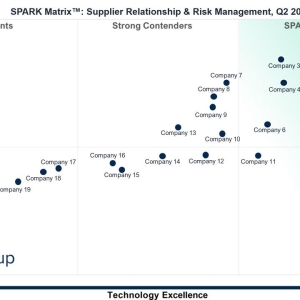
QKS Group's SPARK Matrix evaluates vendors including BirchStreet Systems, Corcentric, Coupa, Esker, GEP, Ivalua, JAGGAER, Medius, Oracle, Proactis, SAP Business Network, SOVRA, SupplyOn, Synertrade, Unit4 (ScanMarket), VORTAL, Workday, and Zycus. The list shows how broad the field has become, from global suites to focused sourcing specialists.
Check SPARK Plus Study Here: https://qksgroup.com/sparkplus?market-id=342&market-name=strategic-sourcing-applications
Key Challenges Businesses Face
Sourcing leaders work under constant pressure. Common obstacles include:
- Manual sourcing events. Email and spreadsheets slow down RFx cycles and make comparison difficult.
- Limited market and supplier insight. Teams often lack data to benchmark prices or find alternate suppliers.
- Supply chain disruption. Global events expose dependence on a few vendors or regions.
- Fragmented contracts. Terms are stored in different places, which weakens enforcement.
- Supplier risk blind spots. Financial, compliance, and geopolitical risks are tracked inconsistently.
- Stakeholder misalignment. Business units, legal, and finance are not always part of the same workflow.
- ESG expectations. Buyers must prove sustainability and ethical practices across the supply base.
Key Trends and Innovations
AI-powered analytics. Platforms classify spend, benchmark pricing, recommend suppliers, and highlight savings opportunities automatically.
Generative AI for sourcing tasks. Drafting RFx documents, summarizing bids, and comparing proposals is becoming faster and more consistent.
Unified sourcing and contracts. Linking sourcing events directly to contract creation preserves negotiated terms and reduces leakage.
Integrated supplier risk. Real-time risk signals now sit inside the sourcing workflow, not in a separate tool.
Real-time collaboration. Shared workspaces let buyers, stakeholders, and suppliers work together without long email chains.
Sustainability insights. Carbon, diversity, and ethical sourcing data are becoming standard evaluation criteria.
Agentic automation. Early AI agents manage routine sourcing steps, such as sending invitations or following up on bids, while buyers focus on negotiation.
Benefits and Business Impact
When sourcing is intelligent and connected, the results are clear:
- Greater savings. Better analysis and competitive events improve pricing.
- Faster cycle times. Automated workflows move events from planning to award more quickly.
- Better decisions. Data-driven comparison improves supplier selection.
- Reduced risk. Early warning signals protect continuity of supply.
- Contract integrity. Awarded terms flow into execution without leakage.
- ESG progress. Sustainability data supports reporting and policy goals.
- Scalability. Standard processes support growth across categories and regions.
Real-World Use Cases
Competitive bidding at scale. A manufacturer runs a multi-round sourcing event for raw materials. The platform scores bids against price, quality, and delivery, and compares suppliers side by side.
Supplier diversification. After a disruption, a retailer uses supplier discovery tools to find alternate sources in different regions, which lowers dependence on a single country.
Contract-linked sourcing. A technology company moves awarded terms directly into its contract repository, so buyers see the negotiated rates when they purchase.
Risk-aware selection. A pharmaceutical firm checks financial health and compliance data during supplier evaluation, avoiding vendors that carry hidden exposure.
Sustainable procurement goals. A consumer goods company adds carbon and diversity criteria to scoring models and rewards suppliers that meet them.
How to Choose the Right Solution
Start with the outcomes you need, such as savings, resilience, or compliance. Then evaluate vendors against these criteria:
- Sourcing depth. Check eRFx, auctions, scoring, and negotiation capabilities.
- Contract integration. Look for a seamless link between awards and contracts.
- Supplier risk and discovery. Review data sources, monitoring, and alerting.
- AI capability. Ask for live demonstrations and customer examples, not roadmap promises.
- Collaboration and usability. Test how easily stakeholders and suppliers participate.
- ESG support. Assess sustainability scoring, reporting, and diversity tracking.
- Integration and scalability. Confirm fit with ERP, procure-to-pay, and data systems.
- Vendor strength. Review roadmap, references, and implementation support.
An independent benchmark helps buyers cut through marketing claims. QKS Group's SPARK Matrix compares vendors on capability, differentiation, and market position, giving teams a practical starting point for shortlisting.
Future Outlook (2025–2028)
Over the next few years, strategic sourcing will become more predictive and more autonomous. AI will suggest sourcing strategies, flag the best timing for events, and manage routine negotiations on lower-value categories.
Global disruptions and compliance pressures will keep supplier resilience and ESG at the top of the agenda. Platforms that combine sourcing, contracts, risk, and sustainability data in one place will gain an edge over point solutions. Vendors that improve decision quality, not just process speed, will lead.
Download Sample Report Here: https://qksgroup.com/download-sample-form/spark-matrix-strategic-sourcing-applications-q3-2025-9352
Conclusion
Sourcing decisions shape cost, risk, and reputation for years. Treating them as a manual, event-by-event task leaves value on the table. A modern Strategic Sourcing Application gives teams intelligence, collaboration, and control in a single environment.
For CXOs and procurement leaders, the next step is to review how sourcing decisions are made today, find the gaps, and compare vendors through an independent lens such as QKS Group's SPARK Matrix.