
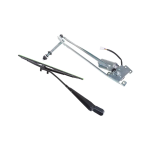

Reliable visibility remains a fundamental requirement for large passenger vehicles, and this requirement places specific demands on wiping systems. A Bus Wiper Motor is commonly designed to operate under heavier loads and wider windshield areas, while a Modular Wiper Motor introduces flexibility that supports different vehicle configurations without redesigning the entire system. These two concepts often intersect in modern vehicle platforms.
Buses typically operate for extended hours and under varying weather conditions. Rain, dust, and road spray accumulate quickly on wide windshields, increasing the importance of consistent wiping performance. The motor responsible for driving the wiper arms must provide steady torque and predictable movement rather than abrupt or irregular motion. This operational stability supports driver focus during long routes and frequent stops.
Modular wiper motor design addresses the need for adaptability. Instead of relying on a single fixed structure, modular systems allow components such as gear housings, mounting brackets, and electrical interfaces to be configured according to vehicle layout. This approach simplifies integration across different bus models while maintaining consistent core functionality.
Mechanical structure influences performance directly. Bus wiper motors often use reinforced housings and robust gear assemblies to manage continuous operation. The modular concept does not reduce this requirement; instead, it separates structural strength from installation flexibility. By keeping load-bearing components standardized and adapting peripheral elements, manufacturers balance durability and versatility.
Electrical characteristics also shape motor behavior. Wiper motors must respond smoothly to control signals, supporting multiple speed settings and intermittent modes. Modular designs make it easier to match motor specifications with different control units, reducing compatibility challenges when vehicle electronics vary between fleets or regions.
Environmental exposure presents another challenge. Bus-mounted wiper motors may face moisture, vibration, and temperature variation. Sealing methods and material selection help protect internal components. Modular systems often incorporate standardized sealing solutions that remain effective even when external mounting structures change.
Maintenance considerations influence adoption as well. Fleet operators value components that can be serviced or replaced with minimal downtime. Modular wiper motors allow individual sections to be accessed or swapped without disturbing the entire assembly. This reduces labor effort and supports predictable maintenance schedules.
Noise and vibration behavior matters in passenger vehicles. A well-balanced motor reduces mechanical noise transmitted through the windshield structure. Gear precision and bearing quality contribute to smoother operation, which benefits both driver comfort and perceived vehicle quality.
Another aspect involves installation efficiency. During vehicle assembly, modular components simplify alignment and fastening. This efficiency supports consistent installation quality across production batches, reducing variation that could affect long-term reliability.