


Europe Behind-the-Meter (BtM) BESS Market: Smarter Homes and Energy Resilience
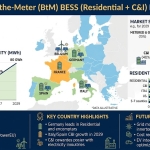
European households are becoming more active in electricity markets. Rooftop solar, electric vehicles, heat pumps, and changing electricity prices are transforming residential consumption patterns. Behind-the-meter batteries can connect these technologies by storing electricity when it is abundant and releasing it when household demand or prices rise. This makes residential storage important to Europe’s decentralized energy transition.
For homeowners with solar panels, self-consumption is often the starting point. Solar generation commonly peaks during daylight hours, while household demand can increase later in the afternoon and evening. A battery allows surplus electricity to be stored rather than exported immediately. The stored energy can then support evening appliances, heating, cooling, and vehicle charging.
Price volatility can strengthen this proposition. Time-of-use and dynamic tariffs allow smart systems to charge when electricity is relatively inexpensive and discharge during more expensive periods. The benefit depends on price differences, battery efficiency, operating limits, and household consumption. Storage economics should therefore use realistic load profiles.
The Europe Behind-the-Meter (BtM) BESS Market Size outlook also points to an important distinction between installed equipment and usable value. A battery may have sufficient capacity but still face limits on export, grid interaction, or flexibility programs. Distribution rules and metering arrangements determine how much theoretical capability can be monetized.
Electric vehicles are adding another dimension. Home charging can create significant evening demand, especially as larger batteries and faster chargers become common. A household storage system can help manage this load by shifting energy from solar generation or lower-cost periods. Energy-management software can coordinate solar, storage, vehicle charging, and household consumption.
Heat pumps create similar opportunities. Electrification of heating can increase winter electricity demand and alter daily load profiles. When paired with storage, smart controls can help households manage peaks while improving the use of locally generated renewable energy. The value of this combination depends heavily on building characteristics, weather patterns, tariff design, and equipment operating schedules.
Resilience is another reason consumers consider home batteries. Backup capability can become valuable where outages are disruptive or grid reliability is a concern. Systems designed for backup must account for critical-load selection, islanding requirements, safety controls, and sufficient reserve capacity.
The residential segment nevertheless faces several challenges. Upfront costs, financing availability, changing incentives, installation quality, and consumer understanding can influence adoption. Policy changes affecting export compensation can also alter payback expectations. As a result, installers increasingly need to explain the full value proposition instead of presenting battery capacity as the primary selling point.
Software and aggregation may create new opportunities. Thousands of residential batteries can potentially operate as a coordinated virtual power plant, responding to system needs while preserving household comfort. Yet this requires reliable communications, accurate metering, consumer permissions, cybersecurity, and settlement processes. Aggregation revenues should therefore be considered only when market access and operational rules are sufficiently clear.
Competition is also moving toward integrated solutions. Hardware suppliers, solar installers, energy retailers, and software providers are increasingly connected through partnerships and service models. Customers may prefer packaged offerings that combine installation, monitoring, maintenance, optimization, and financing.
By 2030, residential batteries are likely to become more than standalone storage devices. Their role will increasingly depend on how well they interact with solar, electric vehicles, heating systems, tariffs, and local networks. The most successful projects will combine customer savings with reliable operational controls.
Europe’s residential behind-the-meter opportunity therefore rests on practical value rather than technology enthusiasm alone. Clear tariffs, quality installations, smart energy management, and consumer-friendly business models can turn household batteries into durable energy assets across diverse European households while supporting renewable integration and grid flexibility.